
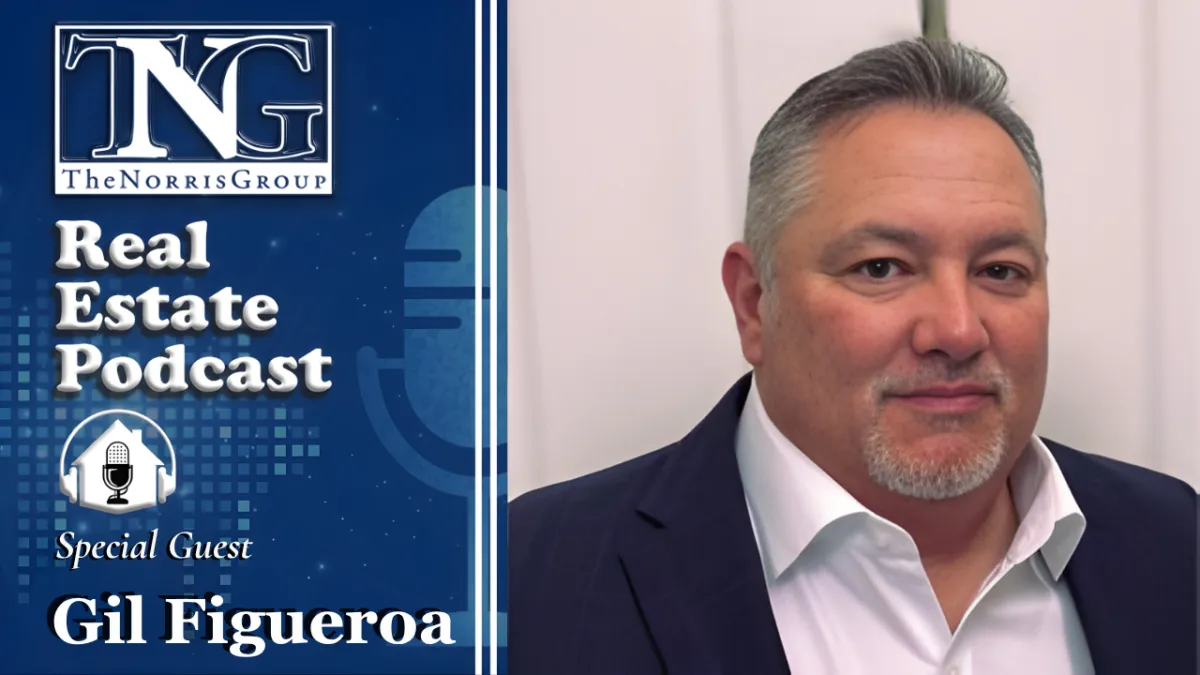
The New Reality of Market Cycles & Lending Strategy with Gil Figueroa Part 1 #955
In this episode of The Norris Group Real Estate Podcast, Bruce Norris is joined by Gil Figueroa, President of First Commercial Capital, for an in-depth discussion on commercial lending, interest rate cycles, and the evolving dynamics of today’s real estate market. The conversation explores how historical market patterns, investor behavior, and macroeconomic forces intersect to influence both residential and commercial real estate performance. Bruce and Gil break down key misconceptions around interest rates, explaining why rate movements alone do not determine property values, and how broader affordability and market psychology play a critical role.
They also dive into Gil’s transition from residential lending to commercial real estate ahead of the 2008 financial crisis, highlighting the risks of loose underwriting standards and the importance of disciplined lending practices. The episode provides valuable insight into how commercial deals are structured today, including cap rates, debt service coverage, loan products, and refinancing challenges in a higher-rate environment. Additionally, the discussion touches on current market conditions, including the “extend and pretend” strategy used by lenders, distressed opportunities emerging in select markets, and why California has yet to see deep discounts compared to other regions.
Gil Figueroa is the President of First Commercial Capital, where he specializes in the origination, underwriting, and closing of multifamily and commercial real estate loans. With over three decades of experience as a licensed Real Estate Broker since 1993, Gil brings deep industry expertise and a comprehensive understanding of the apartment lending, commercial real estate, and mortgage sectors. He is also a seasoned financial analyst and wealth strategist, working with high-net-worth individuals to develop practical investment strategies aligned with long-term financial and retirement goals.
In this episode:
Bruce welcomes Gil Figueroa, President of First Commercial Capital.
Gil shares his 30+ years of experience in commercial and multifamily lending.
Bruce explains how a unique VA property deal led him to study real estate cycles.
Why interest rates alone don’t determine housing prices.
How the 10-year Treasury helps forecast market direction.
The role of human behavior (fear and greed) in market cycles.
Gil discusses Elliott Wave analysis and its impact on his forecasting.
Lessons from the 2007–2008 housing crash and risky lending practices.
Why Gil exited residential lending and shifted to commercial real estate.
Key differences between residential and commercial loan structures.
How rising interest rates impact cap rates and property valuations.
Why affordability is shaping today’s real estate market.
The “lock-in effect” of low mortgage rates on homeowners.
Overview of commercial loan types and refinancing challenges.
Why some investors avoided long-term fixed loans before rates increased.
The “extend and pretend” strategy lenders are using today.
Emerging distressed opportunities in select real estate markets.
Episode
NarratorAnnouncer, welcome to the Norris group real estate podcast, a show committed to bringing you insights from thought leaders shaping the real estate industry. In each episode, we'll dive into conversations with industry experts and local insiders, all aimed at helping you thrive in an ever changing real estate market continuing the legacy that Bruce Norris created, sharing valuable knowledge and empowering you on your real estate journey, whether you're a seasoned pro or a newcomer, this is your go to source for insider tips, market trends and success strategies. Welcome to the
Joey Romero
Norris group real estate Podcast. I'm Joey Romero, and today we have a great conversation lined up for you with a true veteran in the commercial real estate lending space joining us. Today is Gil Figueroa. Figueroa, president of first commercial capital. Gil brings over 30 years of experience as a licensed real estate broker with exceptional expertise in originating, underwriting and closing multifamily and commercial real estate loans. He has a deep understanding of complex loan programs as well as escrow, title and documentation processes, and is known for his ability to identify strategic financing opportunities that create real value for his clients. In addition to his lending background, Gil is an experienced financial analyst and wealth strategist working with high net worth individuals to develop practical investment strategies aligned with long term financial and retirement goals. He is also a seasoned speaker, having spent nearly a decade presenting at wealth conferences and seminars. Today's interview is especially exciting, as Gil will be joined by our very special guest host and former CEO of the Norris group. Yeah, it's that guy, Bruce Norris. So let's get started.
Bruce Norris
Hi. Welcome to our show. My name is Bruce Norris, and today we have a special guest, Gil Figueroa. I met Gil many years ago. We started doing presentations with Chris German, the apartment dealer, and he is one of the very few speakers. I take notes when he talks. So I really respect how he looks at charts and draws conclusions. So Gil, happy to have you back, Bruce.
Gil Figueroa
I'm humbled to be invited in your presence before you say anything. I met you before you met me, because I was in your audience. I believe it was. Was it 2008 okay? Did the the the fallout is coming or
or it's already here?
Gil Figueroa
Yeah, it was, I think it was 2007 or eight, yeah. I mean, it was fantastic. It was everything I thought that was coming. You put it all together in charts. So I'm honored to be here. That's for my
Bruce Norris
mentor, fellow, fellow chart guys, well, you know, it's interesting, because when I did the original study, it happened because of a purchase I made. So I'm, you know, I'm buying real estate, and there is a VA property. This is trying to think about 1995 a VA property up for sale. So anybody that lives in the house as a VA has the chance to bid on it. First, I'd say it's probably worth 40 grand. The opening bids 15, no bidders for the whole country, no bidders. Then it goes to the investor, and I'm the only bidder in the country. And there was a formula that I knew I could get it for 13 three and I'm the only bidder. And to be honest with you, Gil that made no sense to me. It would rent for $500 and no one wanted it on either side of the world of real estate investors or occupants. And it scared me. I said, Okay, I have no idea what happened, because I'm, you know, an investor that took the 85 to 989, run, you know that everything you did was right, and then everything you did kind of turned not right, and now I'm buying a house for 13 three, and no one thinks that's a good idea. Wow. So that's why I started looking at this stuff, that was the motivation, and I didn't even want to figure it out. I wanted to find the person that did. And so I did all the research looking for that person. First went into the library and read all the articles about talking about charts and timing and all that, and I was just never impressed that anybody had nailed it. So that was the start of the journey. And what's really interesting is, I did myself a big favor by not not thinking I already knew something was true. So when you look at interest rates, I you know, I've debated so many people that are like PhDs, and one of the first things they most always say is, of course, when interest rates go down, prices come back. And I'm just thinking, all you have to do is look at an interest rate chart to know that isn't true, which is very odd. So between 74 and 80 interest rates went from eight to 16% So according to their theory, prices got crushed, and prices tripled during that journey. And then, you know, you have 2008 to 2010 or whenever, the interest rates went down by a by a ton, and your prices crashed. So the truth is, if you know the direction of interest rate, and that's all you know, you can't tell me anything about what's what prices do. And so that's the interesting thing when I studied this, and when I when I look at you do what you do, at that, with that one particular chart that you you look at, I know that you studied that, where that has more meaning to you than anybody else, because you really have it's like in science. You go, okay. And so I want to first of all talk about the chart that you usually look at when you were, when you're talking in front of the apartment group, what is it that you're looking at and and what tells you the direction it's it's likely to head?
Gil Figueroa
Wow. So I look at the 10 year treasury. You know there's, there's either the credit the 10 year futures chart, or t and x, which is about the same, so they both track each other. So the market develops certain pattern. All markets do, they develop a pattern, and it's just human characteristics as patterns. You know, optimism, negative, fear, greed. Those are your your basics, and the market moves on on these patterns over the years. I mean, I'll tell you what really got me, you know, really in depth with this market was back in oh eight and oh seven, when you were particularly, you know, right on target about the market falling apart. I was following an Elliot wave technician. They had a newsletter, and their newsletter was predicting the same thing. And I thought that was interesting, that you and them came up with the same collaboration, but yet, with different sciences, as far as what you're looking at, correct me at that, at that time, we were doing maybe 50% production was single family, and it had zero fundamentals. We had the heartbeat loan, where you had zero down and right, only a FICO score, and the income was made up. Like you've said many times, it was definitely made up. We were a broker. We brokered that and and I used to ask the investors, the the country, wide of the worlds, of how do you price this? How does this not mitigate risk without any income documentation or showing the ability to pay. I thought it was outrageous. And they said that, well, you know, we've never had defaults. We haven't had defaults in this market. Our market is very, you know, very little default and, and, and. And my conclusion to that statement was, just because you haven't had them doesn't mean they're not coming. That's right, yeah, so that didn't really correlate to me, and in oh six, I started winding down my company from doing the zero down. I canceled our country, wide contract, which was very prosperous at the time, but country wide had an idea that something was going to blow up, because they wanted us brokers to guarantee or pay the default within 12 months of default. Wow, if a client did any 12 month default, regardless of fraud, US brokers would have to cover that. I said they know more than they're telling us here. Yeah, and this is I can't I can't less rest our small company on this risk. I can't mitigate this risk. There's no way. And that's when I really shifted over to commercial work. I thought it had debt service. It had a real analyzer of what a borrower should look like. It was more tangible. It had real underwriters. They didn't have the more automated systems that that, you know, the single family market has. So I just thought it was the logical approach. So in I believe Oh 809, I closed down my company, which was strictly, like I said, 50, 60% residential, right? And opened first commercial in 2009 strictly on an investor model. Only work with investors, only a non owner model. And we're going to look for, you know, investment assets and residual income, and have great clients that are long term clients. So that was our position change. At that time, my real focus started, not only looking at that Elliot wave forecast newsletter, but also learning that Paul Tudor Jones in 1987 actually made millions. In a matter of days by calling the top of the market. I got to the point where I really researched Him, and to the point where I understood that he was also an Elliott Wave technician, okay, and, and now he's, you know, a billionaire hedge fund. I don't know if he's probably retired. He's in his 70s. I would assume he's retired. I would be and that really caught my interest. Then when the market did drop, as you stated, and a lot of the Elliott Wave guys stated the same thing, I was fascinated. I was hooked right there. I was like, Wait a minute. This is, this is real forecasting. This is not just maybe, this is definitely,
Bruce Norris
yeah, when, when you put something in writing, you're stuck with it for a while, at like forever, especially if you did it in advance of it happening, because it sounded so outrageous. So back then, in in residential real estate, you could do no wrong, everything you invested, even in 2006 exploded in 2007 and we actually had someone on the radio show, I think it was January of oh seven, and a guy I really respected was still having everybody buy houses all over the place. And I told him, you know you can get everybody out. You still have time. You walk away a Hero Man. He had probably 5000 houses he had sold to investors that they they had owned like 20 a piece, and one of them heard me speak, and he came to me, and he had a page like it was stapled together. He had 30 some rentals with negative cash flow of 20 grand a month, but he had a net worth of $3 million and I said, Well, how do you pay for this? He says, I sell other people houses to the same concept. And I said, I think you got six months to run away with your 3 million man, and that's it. And he didn't he
had a net worth on paper, Bruce,
Bruce Norris
I know, yeah, but that could convert, because he was still in that moment where he could sell it all, you know. But boy, after it changes, you know. So how? How closely do interest rates correlate with commercial property valuations? Let's say so if, if interest rates are going up, our apartments automatically getting hit, because it's part of the formula, is that how it works? Or is there, is there times where that's not true?
Gil Figueroa
That's a good question. And I don't have the historical analysis. I didn't prep. You didn't give me any questions. No, you don't perfection is due. I didn't prep for that. But I would say, let's say, in today's market, since, since we hit a peak of, you know when, when we went into 2021, 22 we had the highest price per unit, we had the lowest cap rates. Then rates started to move, and the price per unit dropped. No question, our cap rates increased, no question. And as the rates come high, become higher and higher, there has to be a certain arbitrage between the actual rate and the cap rate for the investor to make any money. So it's, it's, it's a simple analysis of just metrics and math. The only time that that can be circumvented is if there's maybe an underground positive movement towards apartment for whatever reason there, right? You know, see
Bruce Norris
what was really interested about housing. So in California, we were up to maybe a eight and a half nine times multiple of median income. In 1972 we were at 2.2 and so when, when the 70s, the mid 70s, hit and the interest rates went crazy. We probably got up to a five, five and a half multiple. But there was room for all that to happen, because before it wasn't taking any of your money to own a house. And you know, all of a sudden, interest rates went crazy, but prices accelerated and got to that affordability number that we look at and say, Okay, you're done at 17% and then that was replicated. So what's interesting? And I go to this question, when we did one of the last reports talking about maybe a 10 year we either need a 1% mortgage rate or we're going to be price dormant for 10 years, because there's no place to put an extra nickel on a payment. And you know, we've really gone down that path where that's been true, where residential real estate hasn't gone down. But see, this is, this is an interesting question. One of the reasons residential has gone down very much is we have this base of two. And a half percent mortgages to three and a half percent mortgages, and those people have a payment that's rent equal and are going anywhere, okay? So that's very unlikely to be a foreclosure group. But in the commercial world, you may have that rate to start with, but that doesn't mean you have it forever, right?
Gil Figueroa
That's right. Ironically, the 30 year fixed does exist for multifamily, right? So we do have lenders that offer it, but it's always at a higher yield, at least 1% higher than your five year yields. So people can't really, you know, get, Oh, get over that hump. I remember meeting a very big investor worth over 100 million sometime in early 22 and I and I, and he mentioned 30 year fix for his whole portfolio. And I told him, it was the most brilliant move he can make, and I had pricing for him, and he went all the way to the table and decided, nope, I'm going to take a five year and and I said, why you're retiring, you're you're done. I'm telling you, Treasuries are headed to five. You can lock in now at a, you know, two and a half Treasury in mid 22 and he decided to take the three and three quarter rate instead of the five and a quarter rate in a 30 year fixed. He's called me back. He was wrong and I was right, but I rather he had done the right thing. I mean, it takes, it takes a little more of a lump in commercial world to accept the 30 year pricing. Sure, the Fannie Freddie model on single family is little tighter, so there's not enough spreads on that five year for single family compared to the spreads available for multifamily. So there's a different spread, and that makes people little greedy, and people take a five year instead of a 30 year now also, when the rates, as the rates are lower, the leverage will increase. Okay, so you have more leverage because, because of the debt service factor that multi family loans use that single family don't use. They use a a global debt ratio versus a debt, you know, service.
Bruce Norris
So at a very low interest rate, you would get more loan to value, basically, okay, because their payment, their payment conscious, rather than LTV conscious. Okay. What happens? Okay, let's say typical is a five year fixed and then there's an adjustment. Is there always an adjustment possible, or does the loan just get called?
Gil Figueroa
No, no, no. There's balloon loans and there's hybrid loans, just like single family. Okay, you have 30 year amortization with a five year five one ARM, which what they're called. And now we're tied to sofr. Sofr plus two and a half to two and three quarters is the norm. So that rate would be somewhere around six today, in that range, six and a quarter. That's not terrible. It's not terrible. It's not terrible. But, but it is terrible for someone who bought with a three and a half percent rate and be during covid Or right thereafter, and weren't allowed to raise rents because of certain restrictions, especially here in California, and now are dealing with a payment twice as much with maybe the same metrics as what they started with, right?
Bruce Norris
Yeah. I mean, that's the thing you've seen. You've seen that journey of decisions, but also, when the lender looks at what they view the as the value, do you have? Do you have owners having to bring in money to accomplish a refi?
Gil Figueroa
You know, that's funny. You should say that a lot of owners aren't refinancing. They just won't do it. They won't bring money in, and lenders aren't forcing them, which they can. Lenders could force them because technically, they're not performing loans if they're pet servicing, right? But the extend and pretend everything is all right is kind of the, you know, the way it's been.
Bruce Norris
I was kind of wondering if that was the lender's choice, or if there was something above them that said, No, you can't do that.
Gil Figueroa
Well, if it's if it was one lender in trouble with non, non producing loans, or, let's say, in default, then it would be that lender's fault. But this is across the board, Bruce, it's too big. It's a problem, too big to basically call all lenders in default. Then the banking system would be crushed, right? So, so the economy would be, you know, in big trouble. There's a lot of money on non performing, well, non performing debt service, I should say loans. They're still performing. They're paying their. Payments, right? But technically, they're not servicing at that 120 or 115 coverage that they started with. So that's a contractual element of default.
Bruce Norris
Okay, just watching YouTube videos, there's a few big investors of apartments that are starting to buy some wholesale deals where lenders have taken them back. I don't know if that's happening in California, but this is, I think he's in Arizona. We're talking about Phoenix, where he's, you know, buying stuff at 40, 50% off of where the loan was.
Gil Figueroa
Wow. Yeah, I haven't seen it in California yet. I've seen some decent deals, but nothing at that level. I've seen some in Texas that have dropped that far, but I have not seen anything in California as of yet. But my footprint is, you know, generally California for multi family, we do land nationwide, okay, but the majority of our clientele is based in California.
Joey Romero
Well, that's going to do it for this week's episode with Gil Figueroa, president of first commercial capital. Please join us next week for part two. See you then.
Narrator
For more information on hard money loans, trust deed investing and upcoming events with the Norris group, check out the norrisgroup.com for more information on passive investing through the DBL capital Real Estate Investment Fund, please visit DBL, capital.com
Joey Romero
the Norris group originates and services loans in California and Florida under the California Dre license 01219911, Florida mortgage lender license 1577, and NMLS license 1623669, for more information on hard money lending, go to the Norris group.