
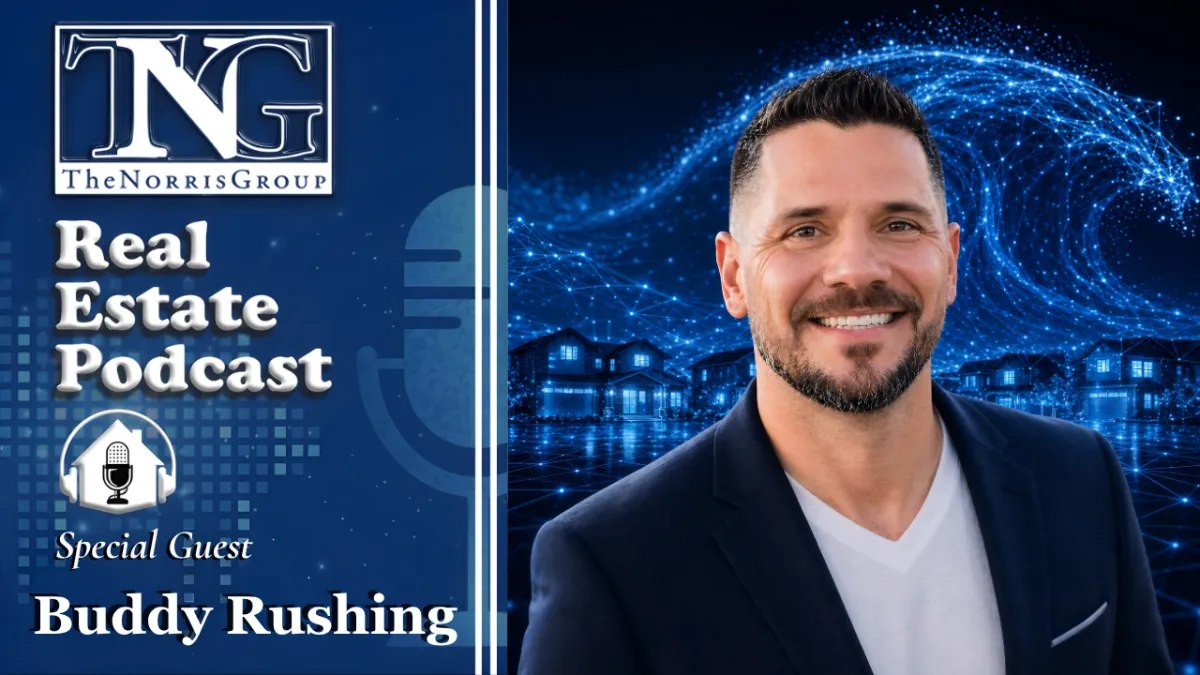
The AI Tsunami: How Investors Can Win Big in Real Estate with Buddy Rushing Part 1 #957
In this episode, Joey Romero sits down with Buddy Rushing, Founder & CEO of White Feather AI, to explore the powerful intersection of artificial intelligence, real estate investing, and financial freedom. Buddy shares his incredible journey from serving 16 years as a Marine Officer and aerospace engineer to becoming a real estate investor, entrepreneur, and AI innovator. He reveals how reading Rich Dad Poor Dad while deployed in Afghanistan sparked a lifelong mission to help veterans and first responders achieve financial independence.
The conversation dives into Buddy’s evolution from leading White Feather Investments into building White Feather AI — a company focused on helping real estate professionals leverage artificial intelligence to stay competitive in a rapidly changing world. Buddy explains why AI is no longer optional, why the “AI window” is closing, and how those who fail to adapt risk being left behind.
Joey and Buddy also discuss the upcoming Tsunami AI & Real Estate Summit, where investors, agents, and entrepreneurs can learn how artificial intelligence is transforming the industry. From uncovering hidden real estate opportunities around billion-dollar data center developments to using AI for automation, efficiency, and deal analysis, Buddy shares why this moment represents a massive opportunity for those ready to act.
Buddy Rushing is the Founder & CEO of White Feather Investments and White Feather AI. A former Marine Officer and graduate of the United States Naval Academy with a degree in Aerospace Engineering, Buddy spent 16 years serving around the world, including multiple deployments to Afghanistan and Southeast Asia. His passion for real estate began after discovering Rich Dad Poor Dad while deployed overseas, inspiring him to build long-term wealth through investing.
Today, Buddy leads a thriving ecosystem focused on helping veterans, first responders, and entrepreneurs create financial freedom. Through White Feather Investments, Veterans for Financial Freedom, and White Feather AI, Buddy has helped build a network responsible for acquiring billions in real estate assets while empowering others through education, mentorship, and AI-driven strategies. He is also the co-founder of AI or Die and co-author of The Science of Getting Rich in the Age of AI, blending timeless wealth-building principles with modern technology
In this episode:
Buddy Rushing shares his origin story from Marine Officer to real estate investor and AI entrepreneur.
How Rich Dad Poor Dad changed Buddy’s life while serving in Afghanistan.
Why White Feather evolved from a real estate company into an AI-first business.
The meaning behind the White Feather name and the mission to support veterans and first responders.
Why AI is becoming essential for real estate investors, agents, and business owners.
The reality that AI will not replace you — but someone using AI might.
Discussion on how up to 50% of agents and service providers may struggle to survive without adopting AI.
Why the “AI window” is closing and why early adopters have a major advantage.
Real estate opportunities tied to AI infrastructure, data centers, and billion-dollar developments.
Buddy’s “Real Estate Goldmine” strategy tied to the Hyperion data center project.
How AI can improve efficiency, reduce costs, and automate repetitive tasks.
The role of AI in helping investors analyze markets, identify opportunities, and scale faster.
Insights into the upcoming Tsunami AI & Real Estate Summit and the value attendees will gain.
How AI is reshaping the future of investing, entrepreneurship, and financial freedom.
Why collaboration and community create long-term success in real estate and business.
Buddy’s mission to help veterans and first responders achieve true freedom through investing and technology.
Episode
Narrator
Announcer, welcome to the Norris group real estate podcast, a show committed to bringing you insights from thought leaders shaping the real estate industry. In each episode, we'll dive into conversations with industry experts and local insiders, all aimed at helping you thrive in an ever changing real estate market, continuing the legacy that Bruce Norris created, sharing valuable knowledge and empowering you on your real estate journey, whether you're a seasoned pro or a newcomer, this is your go to source for insider tips, market trends and success strategies. All right,
Joey Romero
welcome everybody to the Norris group real estate platform. Estate Podcast. Today, we have a very special guest, a friend of the show and a friend of the Norris group for a very long time, huge supporter of I survived real estate for many, many years and and you know, he's interesting, interesting story, with his background in the military and wanting to provide financial freedom to veterans and first responders and things like that. So we'll get into that a little bit more, but let's welcome buddy rushing of white feather. Ai, it's not white feather investment anymore. It's white feather. Ai,
Buddy Rushing
that's right. I talked to somebody this morning about this, and he was like, how's things going? And I'm like, Well, you know, about 18 months ago I made a fundamental shift that white feather was now going to become an AI company that focuses on real estate, as opposed to a real estate company, right? That's a really fundamental shift, and I think that it's warranted because of the awesome power of AI and so, yeah, so here I am on behalf of white feather AI,
Joey Romero
so that's just your latest pivot. Now you you spent, you know, you graduated from the Naval Academy, you spent leave 16 years in the military as a as a naval officer for the Marine Corps. So when you were coming out of service, I guess it's not because I know a little bit more about your background. It wasn't that big a stretch for you to pivot from military to real estate. But talk about how that came about. Just how'd you, how'd you go from, you know, military Astro, aren't you an astrophysicist by trade,
Buddy Rushing
aerospace,
Joey Romero
aerospace engineer, right? So, aerospace engineer to real estate investing. Can you talk about how
Buddy Rushing
that, yeah, yeah. You know, the Naval Academy for me was, you know, just a fire hose blast in the face. You know, I got accepted, barely squeaked in through the door, and then, yeah, I studied aerospace engineering, because it started with an A, and the list of potential majors was alphabetical, so it started with an A, and it was the first one that sounded cool. And I really, really wish that I put more thought into it than that, but that's the truth, and it's it's the most hard, it's the hardest major ever, and I barely made it through, but, but hey, not a single person since I've graduated has asked me what my GPA is. Not a single person. No one cares. So I made it. But then, you know, I went into the Marine Corps, and you know, I got to deployed Afghanistan three times because I graduated in oh four. And then, of course, that's when the war was raging. And you know, I've never even thought about real estate, like I grew up on welfare in East Tennessee, and we never, you know, my parents knew nothing about real estate, you know. And so what changed my life? And it's so wild how things work, because over 20 years ago, I'm in Afghanistan, man Tom flies, I know. Holy cow, I was 2006 Wow. 20 years ago. Anyway, I was in Afghanistan, and I was on an armored convoy, and I found Rich Dad, Poor Dad, just sitting there this little paperback, torn up book, and I read it, and it completely changed what I thought was possible in my life. And you know, after that, of course, 20 years goes by and we go build all this other stuff and build financial freedom and all of that. And you know that we don't have time for that whole story, but like, if you're interested, you can find it online. You just Google buddy rushing like white feather, and there's other podcasts and stuff that's been done. But here's the cool part of the end of the story is, I think, you know, a lot of people know about Robert Kiyosaki writing that book because it's a story about his life, and he's the one that kind of does, he's the front man. But what you what a lot of people don't know, is that the person who wrote a lot of it, the vast majority of his a woman named Sharon Lecter, right? So if you look on Rich Dad, Poor Dad, he actually says, written by Sharon Lecter. Robert kisaibi, So Sharon, I actually met her a couple of years ago, out in advance. And I did not know that military runs throughout her whole family. You know, she her dad, her son, you know, so on and so on. And so she's got a really big heart for the military, and she loved the mission of white feather, which is to help veterans, first responders and their families build fatty and so I. Two weeks ago, we're out in Arizona at the Great Wolf Lodge, and Sharon's husband, Mike sends me a text, and he's like, Hey, you should come out to the ranch. We got a ranch just north of Scottsdale. It's called Cherry Creek Ranch. And so I was like, okay, so we went out there and stayed for like, two days, and they drove out and they came and had dinner with us, and we're just hanging out just, I'm literally sitting around a fire pit, talking for hours with Sharon Lecter.
Joey Romero
That happened
Speaker 1
like, a couple of weeks ago, right? So life's pretty crazy, man,
Joey Romero
wow. And that's wild, you know? So let's, let's get into the whole white feather thing there. I didn't know that there's actually a story about why it's called White Feather. Can you tell us about
Speaker 1
this? Yeah, so it's so funny how things happen, because now, just, just to frame this for you, now, white feather is an ecosystem of people. There's, you know, there's 500 core veterans at the at the center of it, but then there's about 4000 people in the community writ large. And, you know, collectively, we've purchased over $2 billion of real estate in the past, like seven years as a group, and, you know, so on and so on, created 75 millionaires. And there's, it's now this like movement that I'm privileged to be a part of. But when it first started, it was literally nothing. There was literally just like, there was nothing. It was, it was my wife and I were driving. I kind of convinced her that, hey, this Rich Dad, Poor Dad thing, it really could work for us, and we really want build it, right? And so we're driving down the road to a place called 29 palms, which is in California. It's it's by Palm Springs. It's a military town, and it's the dead end of nowhere, deserts, nothing. So
Joey Romero
it's like Beverly, Beverly Hills east. Take
Speaker 1
it together. Yeah, exactly. So you should go there once you go there, and just enjoy yourself. If you don't know why, that's funny, you should just Google 29 Palms, California. Just take a look at the town. I call it Hell's annex. But anyway, so we're driving down the road, and we're like, you know, we're, I don't know why, but we've always believed in ourselves, even when she was driving like dirty like batteries around for NAPA Auto Parts, making 300 bucks a month, and I was a first lieutenant in the Marine Corps. But for whatever reason, we always believed in himself. We always believed that we'd be able to do it. It's naive or whatever, but we're driving, we're like, we're gonna feel this is gonna be big. We're gonna do something great. What do you want to call this business? And we drive by, and we drop by the police station in the road that leads to the police station is called White Feather road. And Kimberly, look at that white feather. That's amazing. It's like, I can imagine in my mind this, like, beautiful, flowing imagery of a white feather and peace and love and happiness. And if you know my wife, that's her, she's peace and love and happiness and all that stuff. I was like, You know what else? White Feather was the nickname of Carlos Hathcock, the deadliest marine sniper in history in Vietnam. He used to stalk the Vietcong, and he was so good and so deadly that he would taunt them by putting a white feather in his camouflage cover. Clearly, that's not camouflage. He was so good that he would be like, I can have a white feather and you still can't find me before I kill you. And he was legendary for that. So his every what's funny is that, obviously, that's completely two different things that really, you know, that really encompasses Kimberly, who's all beauty and love and peace and happiness, and me, who's a Marine, right? And what's really funny is she was like, obviously, like, oh my gosh, I can't believe you were there, but, but she agreed to it. So that's where the name was from. To this day, more people have said, hey, the white feather that's Carlos habcock, right? That have ever referenced peace and love and
Joey Romero
happiness,
Speaker 1
so I win.
Joey Romero
So Kimberly's version of that is the the feather that comes out of the book in Forrest Gump that floats us
Joey Romero
floating little beauty feather
Joey Romero
That's too funny. Now, all right, so we'll get into abundance mentality a little bit later too, but that's kind of what white feather was. It's more about community over competition. Can you talk about
Speaker 1
that? Oh, for sure, a lot of people have remarked over the years that the velocity of trust inside white feather is is the fastest that you've ever seen. And what that means is you get people that come into the community and they meet each other, and then within moments, they're like joining forces and doing deals and loaning each other money and giving each other hours of consultations for free. And right? It's like a perfect example that I can tell you is one where we we had a gathering. It's like 30 people here in Carnes, bats, no big deal, and the vast majority of people at White Feather have not met each other in person. And we're all over the country. We're all over the world, and so most of the time it's just zoom and calls you. And so we had these people come in, and there were four people that came in that had never met each other before. One guy was a West Point grad, one a Naval Academy, one Air Force and one Coast Guard. I can't make this isn't a joke. It's like we they had one y'all
Joey Romero
walked into a bar, just walked
Buddy Rushing
into a bar, and they're already and so they came in and over drinks, they started talking. They were like, Man, you guys are awesome. We should definitely do stuff together. And they're like, Yeah, we will. And then they parted ways. Less than two weeks later, the Air Force guide, a guy named Dave Ortiz, finds this deal on LoopNet down in Coronado, and it's this seven unit sort of multifamily apartment that it's like three different houses, like a three bed, a three, a two and a two. And he finds it on loop net, and it's like two and a half million dollars, or something like that. So he messages the other people, and long story short, less than two months later, they had raised over a million dollars from white feather and bought the property, and then they renovated it and turned it into a short term rental. And they still own it. And their best month, they average over $100,000 a month in income. So it is crushed. And, you know, the whole United States has, like, faced a real big compression in short term rentals. They have been completely resistant to that. And so, so they called it four branches equity, right? And that's the LLC that owns it, and they've done that. It's been a grand slam home run within two weeks of meeting each other. That's the velocity of trust in white feather and about like collaboration versus competition. Competition doesn't even make any sense inside White Feather, because we're all on a path to building financial freedom so we can actually live the dream of freedom that we fight to protect as veterans and service members right and first responders. Because the whole point is this, there are millions of people in America that serve and sacrifice, and quite literally, oftentimes, sacrifice more than just their time and their and their money and their emotion, whatever, but sometimes even physically, right? And they do it to some degree because they want to preserve this American dream. And the American Dream is freedom. It's not white picket fence. It's the freedom to have that white picket fence. It's the freedom to do whatever you want, right? But the irony is that the vast majority of those service that are in that service, they don't get to live that dream. That's okay. They can't afford to you. Afford to. So the mission of white feathers to help those members and their families build financial freedom so they can actually live that dream. So collaboration is the only thing that makes sense. Competition doesn't make sense at all in that, in that mission
Joey Romero
that, and that's what I love about the financial freedom event that you have the summit, because it wasn't just like, I hey, here's some strategies for real estate. It was actually like resources and tools, you know, to help help with, you know, disability, you know, payments. How do you know, a lot of them don't You don't even use their VA benefits to buy houses like VA housing, you know? So it was about those types of tools, and that's what I really love about that community and and and hearing what you're doing with that, because it is not truly just like, hey, finds freedom, but it's, it's well rounded and very robust the support and the structure that it has. So it's really cool,
Buddy Rushing
yeah. And honestly, for anybody that's listening to this that's thinking this up, oh, well, I didn't serve understand that. Like for us, the mission is about helping people who support this dream of freedom. So like that includes spouses. It includes brothers and sisters and kids and parents, and everybody who would consider themselves a patriot, that would consider themselves like, you know, it's weird that that term has gotten a little bit like clouded recently to those of us that love the freedom that America represents, like it's been Chris, it's always crystal clear, like it's all you have to do is like, look At the opportunity for a kid like a half Mexican kid who grew up on food stamps in an abusive household, who now is a multi millionaire that's helping people build their dreams. That's my story, and that story is only available because of the freedoms we have in America. So that's what I'm passionate about, is the freedom. It's not about politics or this or that, or left direct, I don't care about all that stuff. That's just me personally. If you care, that's great, but you have the freedom to care. I have the freedom to not care. That's what the whole point is. And without financial freedom, all the other stuff is just talk, that's
Joey Romero
and and sports is a little bit like military service in that way, where it just like you might come from, from Tennessee, and then you're, you're in boot camp with a kid from South Central Los Angeles,
Joey Romero
yeah,
Joey Romero
and that guy might be your best friend for the rest of your life. That's
Buddy Rushing
right, you know? And
Joey Romero
that's what's really cool, because that, that all this all happens in in baseball and in football, you know, people from different neighborhoods come to the same high school. And all of a sudden, you know where, where you wouldn't have somebody over, they end up developing these bonds and they carry through your lifetime. So that's really cool,
Buddy Rushing
yeah, now imagine creating a community of people that have that shared background and a heart for service, right?
Joey Romero
Yeah, that's, that's really awesome. All right, so, you know, I know we dove deep into a lot of the stuff the white feather does in the past, in our in our podcast, but you know, you talk about your first pivot now you you made a huge pivot, and we alluded to it a little bit, you know, when we first started. And it's actually one of the reasons why we're doing, if anybody doesn't know, we are doing a AI meets real estate event, and it's going to we're going to do a little bit of a preview later on, but because this is going to be two parts, I want to mention it early in the show too. It's called tsunami, the real estate AI Summit. How investors win when a artificial intelligence changes everything. So let's talk about that where you you were doing all this and just real estate and helping support, what sparked the pivot to AI for you,
Buddy Rushing
it was a personal interest that I had in exponential technology. Really, it comes down to, well, it's lucky. I got lucky because I personally am interested in the all the things that are changing, everything from autonomous robot like humanoid robots to autonomous driving cars to flying cars to, you know, all this stuff is fascinating to me. I just think, like spaceships, you know, SpaceX, and like, you know, mass drivers off the moon, and data centers. It's all really cool stuff to me. And I think it's the most amazing time in human history to be alive. And if you truly do pay attention, that becomes really obvious, and think about what happens when that happens. If you really do believe that it's the most amazing time in human history to be alive, then you're excited for every day. And I have crap in my life, just like everybody else. I have deals that go bad. I have frustrations with contractors. I have I have all of this stuff that everybody else deals with, but it's easier to deal with that stuff if you truly believe that it's the most exciting time in human history to be alive, and all you have to do is look at the data and it becomes really becomes really, really apparent that we are we're in the safest we're in the most prosperous, we're in the most opportunistic time and ever, ever in human history. So for me, it started with just being personally interested. I read the book abundance. I started following Peter Diamandis and the whole abundance community, and started learning about all these technical things. Well, the conversations five years ago were all about flying cars, robotics, computation, stuff like that. Then it started shifting right? And then you started hearing a little bit about AI, and then chat GPT launched three years ago, I think it was. And then all of a sudden, people are like, whoa, what's this Chatbot? This is really interesting. Let's talk about this more. And then about two years ago, my community, and the community of the abundance community, I started feeling a shift from we're talking about AI's one thing to half the time we're talking about AI. And I saw in my mind, I was like, you know, what? I heard somebody utter the phrase, AI or die. And it stuck with me. That's obviously dramatic, but it stuck with me. And I was thinking to myself, I was like, you know, with all of the parts that AI has the ability to touch and will in the coming years, those that sit idly by will be completely encircled and completely outflanked by those that are embracing this technology. It's an unfair advantage. AI is an unfair advantage. And I heard somebody say this, and it stuck with me as well. They said, AI is not going to take your job. By and large, it may take some people's jobs, but for those of you that are saying, Oh, well, AI will never take my job. That's not the threat. The threat is your competition, who's using AI better than you, who's going to take your clients and your business and that job opportunity, that job may still exist, but you won't get it, because the person who's using AI better than you is more valuable than you, and that's a hard, stark reality. But I looked internally at White feathered and I said, if we don't disrupt ourselves, other people are going to disrupt us, because what we're providing is not magic, right? I'm helping people ideals. I'm helping them get their benefits, I'm helping them do loans. I'm helping educate them on how to build financial freedom. All of this stuff is not magic. It's something I learned from somebody that I'm teaching to other people. But what if somebody else, using AI can do it way better and faster and cheaper than me. Loyalty only lasts so long until they optimize for what their mission is, which is to build financial freedom. And so I said, Okay, it's AI or die two years ago. I said this. I said, I don't know what this looks like. I told my business partner, Greg. I said, we're AI or die. I don't know what it looks like, but we will become an AI. Of company. And then about a year ago, I had learned a lot. And now, by the way, a year ago, all these podcasts, I listened to everything. It's all AI. We're taught. We talk about robotics a little bit, we talk about SpaceX a little bit, we talk about flying cars a little bit, but it's AI, everything. And so that was pretty
Joey Romero
well, that's, that's the Dennis asabis method. Is like, build the artificial super intelligence and it's going to solve everything else.
Buddy Rushing
It solves everything that's it's become. So for us, I'm like, okay, and I'm about nine or 10 months ago, I said, Okay, we need to go all in even more, right? So fundamentally, White Feather has to become an AI company where AI is the electricity. It's literally the utility. It's the electricity that powers all the other verticals of AI. White Feather investments, doing deals powered by AI. White Feather education powered by AI, you know. And so all the things that we're doing now, everything is powered by AI, and everything is running so much more powerfully than it ever used to be. Like we have a campaign, real estate investing campaign called the Hyperion.
Joey Romero
Yeah, why don't you talk about that a little bit, but not too much, because we're gonna do a deep dive.
Buddy Rushing
All right, yeah, yeah, I forgot. I'm terrible at promoting things. So anybody that listens to this, come to the event, that's what you're supposed to be doing. But I'm terrible at promoting terrible at promoting, so I'll just, I don't
Joey Romero
know, but go ahead and share what you guys are doing
Joey Romero
right
Buddy Rushing
now. Yeah, so we so I said, Okay, now that I'm AI native, I'm just like, I'm just this AI guy that is looking for different opportunities to use AI. What about real estate? How does AI meet real estate? And I was like, well, obviously, the obvious ones, you can upload your property management statement, you can upload inspection reports and blah, blah, blah, all the simple stuff. By the way, everybody who says, Let me, let me give you two steps real quick only, or there's 40% of Americans that state that they don't use AI in any capacity. That's one, that's insane. Two, the 60% that do state they use it. The vast majority of those mean they're using chatgpt as a Google Plus. That's what they mean. Their search chatgpt is now their search engine that is like, you know, dipping the tiniest part of your toe into the ocean and saying that you're an Olympic swimmer, right? It's like it. So when I say, you know, using AI, I mean using it to its fullest. So what we just said, All right, where's real estate? Meet AI. You can use it to for due diligence, for sure. You can use it for analysis. Okay, all that's great. But what about even more fundamentally structured than that? Data centers. Right? Data centers? They're building data centers because, for those of you that don't know, the President of United States and all of his administration has stated publicly that it is a national security imperative to beat China to in the AI race. In order to beat China in the AI race, you have to have AI that AI is run on Compute, which is produced by chips. Okay, so stick with me. This is a little bit nerdy, but it's really important to understand this chip, this stack AI sits on the very top of chips. Chips are housed in data centers. Data centers are run by electricity. I'm oversimplifying, but you get that stack. Imagine that. You
Joey Romero
mean I'm going to get into transformers and GPUs
Joey Romero
at
Buddy Rushing
the events. At the event, I'll tell you anything you want to know about TSMC and the whole geopolitical anyway. So they, in order to have the computing capacity and the ability to beat China to AI, we need lots of data centers. Those data centers are massive, massive projects, billion dollar projects, 10s of billions of dollars. And I was like, wow, what happens when you pour billions of dollars of infrastructure into an area? What happens to the real estate? It seems pretty obvious, right? Anytime you've seen an infrastructure project go into a town, the real estate values go up, the rent goes up because the taxes go up, right? And so but we've never seen anything like $30 billion worth of construction. So let's take a look at that. Long story short, I did about three months of AI powered due diligence, and come to find out, there was a $37 billion data center by meta, called Hyperion, that was being put into northeast Louisiana. And when you look at where it's going in northeast Louisiana, it's in the middle of farmland. And that makes sense. The land is cheap to lease. They have a high water table for cooling operations, and they have an abundance of natural gas for power So, and they have a friendly local government. So then I said, Okay, well, let's look at the town around it. And the town is median home price 170,000 Do you know that the median home price in America is 430,000 you know that there is plenty of room for
Joey Romero
a little bit
Buddy Rushing
upside, little bit of upside. So what happens when they. Bring in 10,000 workers for three years, and they got to live somewhere, and they get high paying jobs, they flood the local economy with money. So this is not rocket science, right? It's and so we went in there and we said, You know what, let's just buy a bunch of properties. So we're 24 properties in right now, and our average purchase price is around 200,000 we do some renovations. Our average ARV is around 285 we're renting them for they're all 1% properties, every single one of them. So our average rent is somewhere between 20 603 grand a month. And so these are multi double digit cash on cash return deals with normal bank financing right now I'm in this market, and we actually so I bought a house on Carter Street, right? 2004 Carter Street, if you want to look at it, it's owned by Hyperion Carter LLC, which is an LLC that I own, right? So, 2004 Carter Street in West Monroe. I bought it for 170 I put about 60 grand into it, and then I refinanced the money back out of it, and then I rented it. I rented it for $2,600 a month, right? And the guy, wanted to move in before we could clean the house. He paid up front the deposit and the first month's rent, and wanted to move in before we could even clean the house after renovation, and in a year from now, that property is projected to be able to be rented for $3,000 a month. So my cash and cash return is multiple double digits, and I didn't do anything special. I just bought it with bank financing, renovated it, refinanced it, simple stuff. And so our Hyperion campaign, and by the way, everybody that's a part of this Hyperion campaign, they're all students. They're all students that I train to use AI and then go do this, and we are like, we're punching way above our weight class, because AI enables us to do that
Joey Romero
well. And that's the thing. It's not like AI is building a data center. You have multiple frontier labs that are doing it all over the country, all over the world, actually, because it started outside of the United States. And then, you know, there's that little bit of the nimbyism because of there's there's bad press, and you know, they're the new ones are going to have to address that before they come in, right? So the drain on the water supply, the drain on power, the spiking of the utilities, well, they know that now. So as these new ones come on board, they're going to have to be able to have like they're even talking about, well, let's not be a strain on the local utilities. Let's find a way to give back and make the utilities actually cheaper.
Buddy Rushing
That's right, right, right. So, so, so the average person without AI that's just looking at this is going to say, oh, you know, Northern Virginia, there was a lot of backlash. And now you look at the protests in New York and California data centers are not a thing. They're not going to happen because they're doing moratoriums. If that's what you want to believe, that's fine by me. But if you look deeper, you understand that meta, not only is northeast Louisiana the the chair, the Speaker of the House right of representatives, is a guy named Mike Johnson who is a Louisiana native. The Congresswoman Julia lutlow, who is running for Senate right now, is actually from Monroe, right you've got Congressman Neil riser, who's from Louisiana. You've got all of these people in in houses of power in DC that are PRO data center. And from Louisiana, then you go all the way down to the local mayor, a guy named Friday Ellis in Monroe, and then washed Harrison. You look at all of these different people that are in charge of either approving or not approving this stuff. 100% of them are on board with meta. And also meta came in and they said, You know what? There's a very high water table in this area of Richland parish. So we're going to dig these massive reservoirs. And if you look at Google Earth, they have these massive reservoirs that are already full of water. That is what they use. So they don't tap into the local town's water supply. The town's too small, so they're so they're not draining the town's water supply. And then they're building two massive power plants Northwest, they've got, they've already contracted energy to build these massive power plants that run off natural gas, and their plan is to produce so much energy that they actually subsidize the local people's electric bill. So when you understand that, and you understand that also that this Hyperion data center is the flagship operation for metas AI operations, then you're like, there's a less than 5% chance of it not happening. And we've run through all of those calculations already.
Joey Romero
Yeah, there's been a lot of talk that that the AI's arms race is has a lot of Oppenheimer parallels, you know? And
Narrator
it does.
Joey Romero
And what's crazy about this is that it's, it's public funding, it's like, it's, it's companies. Because if this was a military and a government kind of deal, then we wouldn't be reaping the benefits of this as fast, you know, because they, they would keep it under wraps law, but because there's such competition between open and I, between them. Anthropic between, you know, Gemini, that it's making it accessible for us and at a pretty good price.
Buddy Rushing
Oh, that's a really important point. So this is something if you've gotten lost so far or you're just like, Whoa, this is over my head. Just remember, this the tools that we have available right now because of what you just said, they're all trying to get market share. Everybody's trying to be open. Ai X, AI, you know, anthropic and so on. They're all out there trying to get users. And how do you get users? You offer things for free or low cost that are where the value proposition is so high that you're dumb not to use it. That's not a business model that can sustain, though. So what happens? They do just like Amazon did. Amazon for 10 years, promoted its loss leaders and lost money every single year until they became so ubiquitous that they were a utility, and then they started charging for Amazon Prime. You remember when Amazon Prime is free, and when all the, you know, the Amazon Prime was a loss leader. They lost money with Amazon Prime. You remember when Amazon Prime video first came out? Every single video on there was free. Now you have to pay for almost everything.
Joey Romero
Yeah,
Buddy Rushing
right. Why? Because they have to make money. So all of these tools that are available right now that we're using to create massive amounts of wealth, they're not going to last. They're going to become enterprise level, and they're going to cost five to 10 times as much. So anyway, right now is the heyday for all of us.
Joey Romero
So let you know that
Buddy Rushing
windows closed.
Joey Romero
The one thing that that you know, especially Craig, you know, our CEO. He's not a huge AI expert, you know. So he's letting you, and I kind of run with with the event, and really develop the programming for it. But the one thing that he always talks about is, all right, let's bring it back to real estate. Let's bring it back to real estate. And that's one of the things that, no matter how technical we get on that day, it's all going to lead back to how our real estate investor is going to use so what's the biggest threat to real estate investors right now, when it where it comes to AI?
Buddy Rushing
Let me, let me frame it this way. And I'll hit four different types of people as well. It is. I was talking to a mortgage broker friend of mine today, and I was asking about how he incorporates AI, and he goes, You know, it's, we try to do it this way. In this way and this way, and we're doing it a little bit. I'm open to it, but I gotta be honest, I don't want it to replace, like, the actual personal connection that I have with people. And I told him something, and I'll tell this to you guys, maybe the most important thing that you hear, AI will not get rid of mortgage brokers. It will not get rid of real estate agents or property managers or investors. What it'll do is it'll completely eviscerate the 50% or more bottom feeders that are amateurs that and I don't mean that to sound so offensive, but you have all kinds of real estate agents. You have really good ones, and you have lots that are not, those lots that are not are going to get annihilated the ones that are really good are going to use AI to do all of the data entry, all of the analytics, all of the repetitive electronic tasks and so on. They're going to lower their overhead, and they're going to free themselves up to do what they do best, which is build trust in a personal way with their clients. And so they can cater to their clients in a much better way, and they can do it cheaper because their overhead is lower because they've automated a lot of this stuff. Like, we use open I use open claw. I'm already, I've already saved, like, over $30,000 a year just in things I was paying for that, that my openclaw Maverick does for free. And that's just one tiny little example. I've got a guy who, you know, we installed openclaw For him, and we're training him how to use it and everything, and he, by the way, public service announcement, don't go download openclaw on your personal computer.
Joey Romero
Yes, we're gonna, that's one of the things we'll talk about. June.
Joey Romero
Is
Buddy Rushing
powerful, risk
Joey Romero
and safety.
Buddy Rushing
Yes, very powerful, very potentially dangerous. If, if channels correctly, it's, it's unbelievably powerful. If done incorrectly, you can really hurt yourself. So please don't go do that without supervision. But this is a guy who runs a bunch of medical clinics, and, you know, they bill what happens is he, you know, he, he has all this work that's done, and then he bills insurance companies, and he bills about $70 million a year, and about 15% of that is lost and denied because paperwork problems. The paperwork is submitted incorrectly, and so on. That's wiffle ball for open claw. Like it's wiffle ball to train it properly, to fill out documentation and do digital data input. And so even if he recoups 10% of what he lost. That's about $1.2 million a year that he'll make, right? And that's one small example. So what I tell people is, if you're a real estate agent and you're good and you can harness the awesome power of AI, you will dominate your competition. Position if you're not, no one's going to come. No one's going to come list their house with you for five or 6% when you're not powered by AI, and the guy next to you or the girl next to you that's fully powered by AI is charging me 3% because they have lower overhead, I'm going to go with them. So like, if you're a real estate agent and you're not using AI, you're going to see very, very rapidly that even your most loyal clients will go work with the other guy, because they're powered by AI. It's the same thing with property managers. Property Managers can charge 6% if their overhead is nominal, right? And they have systems where their tenants stay longer and their marketing is better, and either customer service is better, all of that stuff is going to make them be able to manage many, many more properties than a non AI native property manager, and the same thing with investors and everything. So the answer your question is parallel. It's two sided. There is the risk if you don't, and the risk is very, very simple, like you will gradually just lose your clients and lose your investment opportunities. And you know that's what's going to happen. It's already happening. The opportunity, though, because you're hearing this information about six months ahead of where most people are going to take it on board, you have the opportunity to harness it. And we'll give many examples at the event, specific physical examples of how people are doing it.
Joey Romero
Yeah, one of the things that we talked about, you and I is doing maybe a couple of webinars that will actually highlight some of the things that you just talked about, like how you know an investor with or without, AI, real estate agent with or without AI. One of the interesting things that I realized when I was developing the webinar for the real estate Realtors is there is, you know, ReMax, you know, the big companies, they're using AI, they're making it available. But even realtors that work for these companies that give you the tools, only about 20% are using them, you know. And so as you go down to the middle and the small brokers, it's even less and less. And so one of the things that I love about our event is that we're going to introduce, like, if you're a brand, brand new, never touched, AI. We're going to start and build you up from, you know, from just talking about how to just prompt engineer, do just bring AI to the table with their chat, GPD, whatever your favorite, you know, AI. Start using it all the way up to, you know, these, these, really, you know, like you just talked about open cloud. We do some live demonstrations. And so, so the webinar is going to say, Hey, this is the opportunity that's presented. And then at the event, we're actually going to do some live demonstrations on how to use a lot of the tools that we're going to talk about. So
Buddy Rushing
even more than live demonstrations, here's what I'll say, if you come to the event, come prepared to get a huge amount of information that you don't need to take notes. We're going to have, there's many, many platforms that we can use, plot, Otter, what have you. We will be recording all of it, and then you will, within an hour of the end of the event, receive, for those of you that want it, receive a document that is a transcript of the entire day that you can upload to your specially trained AI that can give you all of the takeaways as it relates to your business. And so one of the things that we're going to do at the event is we will have a segment. I don't I haven't told you about this, Jerry, but I want to do this. I'm going to have a segment where we walk you to everyone should come with a laptop, right? So, or a phone, but preferably a laptop. We're going to walk you through how to build your own Maverick. My AI is named Maverick, right? And I especially train him to do everything from how to engage with me to create, you know, dopamine releases as I talk to him how to create flow states in me, but also how to fight creativity and then execute things I need him to execute. How I built Maverick, I learned over a course of a year how to do this. I can take you though in less than 30 minutes, and I can help you build your own version of maverick with whatever you want. Gemini, Chad, I don't care, right? So you will leave, if you come to the event, you will leave with your own specially trained AI assistant, and then you'll leave with a synopsis of the entire or without with a transcript of the entire day's events that you can then feed into your AI assistant and give you not just the takeaways, but a plan of action for how to incorporate what you've learned into your 90 day action plan. Tell me an event that you can go to where you see that I've never seen one.
Joey Romero
I was so excited. I'm so excited that, you know, Craig, Craig has authorized me to do a something that we were haven't done. So what I'm going to do is. Is, I'm gonna announce today that we're actually gonna do a super early bird where, not only are they gonna get 100 bucks off, they're gonna get $200 off. So it's only gonna last for two weeks.
Buddy Rushing
How'd you get credit?
Joey Romero
Yes,
Speaker 1
funny for
Joey Romero
two weeks. You know, he's like, this is brought to you by DBL capital. You know
Buddy Rushing
exactly, you
Joey Romero
know, so just
Buddy Rushing
a little commercial in there.
Joey Romero
Yes. So, so we're gonna do that, so starting this Friday. So when we air this event, this this podcast, the first half, we're gonna send out the coupon code to give you $200 off our price tag. So we want everybody to show up. Because I think once, once we get people in the room, they're going to be like, blown away, and they're like, give us more. That's going to do it for part one of our interview with white feather AI CEO and founder buddy rushing. Please stay tuned. We'll see you then.
Narrator
For more information on hard money loans, trust deed investing and upcoming events with the Norris group, check out the norrisgroup.com. For more information on passive investing through the DBL capital Real Estate Investment Fund, please visit DBL capital.com
Joey Romero
the Norris group originates in services loans in California and Florida under the California Dre license, 01219911, Florida mortgage lender, license 1577, and NMLS license 1623669, for more information on hard money lending, go to the Norris group com and click the hard money tab.