
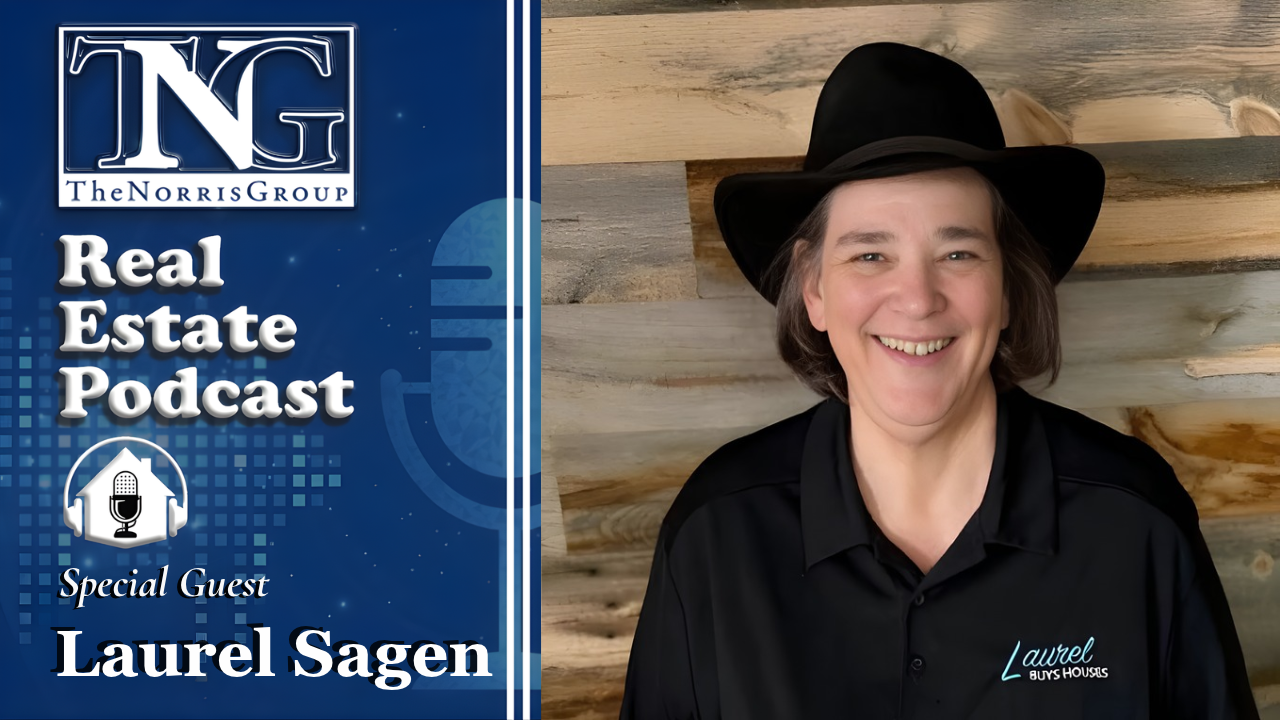
Building a Real Estate Business Through Flipping and Wholesaling with Laurel Sagen | Part 1 #974
In Part 1 of the Norris Group Real Estate Podcast, Joey Romero sits down with Laurel Sagen, founder of Laurel Buys Houses, to discuss her journey in real estate investing and how she built a successful business through changing market conditions. From starting with rental properties to navigating the 2008 financial crisis, Laurel shares the experiences that shaped her investment strategies and business decisions.
Laurel explains how the housing crash affected her rental portfolio, the financial challenges she faced, and why she eventually shifted her focus toward house flipping and wholesaling. She shares how she and her business partner rebuilt their company by purchasing and renovating bank-owned properties, gradually growing their operation to approximately 1,000 house flips over the following decade.
The conversation also explores how Laurel transitioned from flipping houses to wholesaling, developed the Laurel Buys Houses brand, and became the face of her company. She discusses the importance of personal branding, strategic partnerships, marketing, and adapting business strategies to meet the changing needs of homeowners and the real estate market.
Laurel Sagen is a Sacramento native, real estate investor, licensed contractor, author, and founder of Laurel Buys Houses, a family-run real estate business established in 1999. With more than 25 years of experience, she has helped Sacramento-area homeowners navigate challenging property situations, including foreclosure, inherited homes, relocation, and properties requiring significant repairs. She is also the author of Your Next Move, Hoarding, and The Inheritance Puzzle. Her company has been featured on HGTV, FOX40, and Good Day Sacramento. Through her experience in real estate investing, house flipping, and wholesaling, Laurel emphasizes the importance of adapting to market changes, building strong partnerships, continuous education, and creating a business that makes a meaningful difference in people's lives.
In this episode:
How Laurel transitioned from sales, social work, and technical recruiting into real estate investing.
Why sales experience and the ability to understand people's needs are essential to becoming a successful entrepreneur.
How she started investing in rental properties using lessons from Robert Kiyosaki.
The costly lessons she learned from holding rental properties during the 2008 financial crisis.
How she and her business partner rebuilt their business through house flipping and wholesaling.
Why she decided to build her personal brand through Laurel Buys Houses.
How masterminds and continuing education helped her grow her business and discover new opportunities.
The importance of strong business partnerships, financial discipline, and creating a business that helps people in the community.
Episode:
Narrator
Welcome to the Norris Group real estate podcast, a show committed to bringing you insights from thought leaders shaping the real estate industry. In each episode we'll dive into conversations with industry experts and local insiders, all aimed at helping you thrive in an ever-changing real estate market. Continuing the legacy that Bruce Norris created, sharing valuable knowledge and empowering you on your real estate journey.
Whether you're a seasoned pro or a newcomer, this is your go to source for insider tips, market trends and success strategy. Welcome everybody to the Norris Group real estate podcast. Today I'm joined by Laurel Sagan.
Laurel was born and raised in Sacramento and founded Laurel Bodies Houses in 1999. She's a real estate investor, licensed contractor, and author whose books cover topics like inherited homes and hoarding. We'll talk about what she did before real estate, how she adapted through the 2008 financial crisis, and how the value she started with still shaped the way she does business today.
Let's welcome Laurel to the show. All right, well, welcome everybody. We're here again with a longtime friend of the show and a friend of the Norris Group, Laurel Sagan.
Laurel, it is really good to see you. Thanks for joining us again. Awesome.
Thanks, Joe. I haven't seen you for a minute, so it's really good to see you doing really well here. Yes.
It's been a while since we've had you on the podcast, so we've got some new listeners and some old listeners that they still tell me that they listen. It's like, oh, I love watching you. Then I get to run into some folks that are like, hey, man, I really like your new podcast.
I'm like, oh, it's not new. It's almost 1,000 episodes. I wanted to get into just a little bit what you were doing before you got into real estate.
What is it that you were doing before you got into real estate? Well, my early career was in sales, lots of different sales jobs. I worked at one company for like 12 years, worked my way up, my first job, and then got into different kinds of sales. Then I was in social work.
Then I became a technical recruiter and started making a bunch of money. Then I tried to figure out how I could keep that level of income, and that's when I got into real estate. That had been 1999.
Technical recruiter, you're recruiting people into tech companies, things like that? Yeah, I worked for Barclays Global Investors. I worked for Microsoft, WebTV, some of the big players in Silicon Valley at the time. Then we did a lot of old school, like Cobalt stuff for the university, the office of the president of the University of California, Davis, other stuff, big mainframe contractors.
I had both contractors. I was really good at placing technical managers into long term positions. I went from making $9,000 a year to making $10,000 or $15,000 a month.
A little bit of a change. Wow. Yeah.
My wife really decided she liked that much better. That got me an urger. When I was looking, because I knew tech was going to, this was a thing.
It was going to die. By 2004, I was totally out of tech and into real estate. I caught the tech bubble.
I didn't catch the real estate bubble. I didn't know that that was coming. We'll get into that a little bit.
Out of all the jobs that you had leading up to real estate, which one do you think prepared you the most for this career in real estate that you have now? Well, of course, sales was really, really important. I always recommend to people who want to do anything and succeed as an entrepreneur, get sales training, but actually social work. Really? Right.
Having to navigate all the different needs and wants of people and thinking outside the box for solutions and really learning how to listen to people. The social work was probably the most that I lean on now. I had a lot of great training from great mentors to deal with people where they are.
That was big deal. That was the last job that I held before I came to the Norse Group. I worked for a nonprofit called the Family Service Association.
I was running a bus that would take, we retrofitted it, and we would take it to food deserts so that they could have fresh fruits and vegetables and healthy eating to senior centers or low income facilities. One of the things that it changed me, it changed my empathetic lens that I had for people. Do you think that did the same thing for you? Well, yeah.
The other thing was, I learned there's more than one way to skin a cat. Does that make sense? You've got to meet people where they are. Not everybody thinks the same.
If you're going to make a real difference in someone's life, you need to get in there. Then there's some things you need to learn that there are some issues you cannot make a difference with. If someone's not well, you can't get them to work.
They're not well. You got to meet people where they are and move things along and get on the same side of the table with them. I think that was big for me to learn that.
Just because I think I know the answer doesn't mean I do. I think that's why Bruce goes back to a lot of the stories that impacted him are the big sale. It's the people stories.
Those are the things that he remembers. Those are the things that changed his perspective on the type of career. It went from, hey, this is a great business where you can make a ton of money to, oh my goodness, I'm in the people business.
I'm in this helping people start over business. I have to put to some great education. I did Jim Marone.
I went to a couple of his weekend seminars. Then I realized that making money is not going to be enough. Zig Ziglar, the more I help people get what they want, the more I'm going to get what I want.
To really trust some of the lessons of my youth from Bible studies in which God will take care of you if you take care of people around you. If you're going to make money, you might as well make a difference too. Then that all impacted me early in my career, in my real estate career.
Let's get into how you got into it. How did you actually get into real estate and investing? Oh, it was pretty funny. My wife was like, we were leaving.
First 20 years of our marriage, we went on like five vacations. Then during this time when we were doing this tech stuff, we went on 20 vacations in four years. We were going on vacation all the time.
We were running through the airport. I knew that this tech bubble was going to break. I saw this book by Robert Kiyosaki called Retire Rich, Retire Young.
I grabbed that book and read it on the plane and then started playing the cash flow game. Have you ever played that game? I've heard so many investors. I haven't done it myself, no.
I started reading the book. We were in the Bay Area at the time because that's where all the tech was, but we had grown up in Sacramento. On the weekends, we started doing exactly what, what's his name, Dyke something, Dyche? The Australian guy on Robert Kiyosaki's team said to drive this grid.
We called every house and we called all these real estate agents. We just started with our friends we were playing cash flow with. We started buying houses and off we went.
Then I got out just before the tech bubble broke and had sold all my stocks in all the companies I had been working for. I had a little bit of cash and we started in 99, 2000, 2001, 2003 buying rentals. We actually stopped by 2003 because the numbers weren't making any sense, but we still got killed.
Do you still remember what your first house that you bought as an investment was? Yeah, I still own it. It's one of the only ones. I only own two houses personally.
The first house I bought when I was in college to live in and I have that rented out. Then this first house I bought as an investor, which I refinanced it four or five times to buy the next houses. I still own that.
It's rented out. Those are the only two I personally own. My business partner and I own some LLC and some other stuff.
How did you find that house? A real estate agent. Then I had to make the agent make my offer the way I wanted to make it. They were like, oh no, you can't offer that.
Oh my God. I did what Robert Kiyosaki said to do. I bought that house and then we fixed it up, refinanced it, bought some more houses.
We still own that house. It's almost paid off now too. Time to refi it again.
In the crazy times, we had a second on it. We had to renegotiate the second for pennies on the dollar to keep it. It was crazy times back there in 2006, 2007, 2008.
Yeah. Don't get ahead of me yet. That's how we got into it.
We were buying a house, fixing up, refinancing and buying another house and renting them out. Now you said you had a bunch of them. I've heard the number, but let's say you had just a bunch of rentals, but eventually you went to almost nothing but flipping.
What made you- Yeah. Well, one, I hated being a landlord. It was horrible.
I was landlording on myself and making all the mistakes you could make as a landlord. Then people were hearing that you didn't have to make your rent payment. People stopped paying the rent.
I drained my 401k. Trying to keep these properties. When you have different business partners too, some business partners will stand shoulder to shoulder.
Others will point their fingers at you and blame you. I learned a lot about business partners back then too. It was a bloodbath.
We ended up losing most of the properties or selling them. My current business partner, who's been my business partner for a really, really long time now, like 20 years, he owns some properties too, but he sold them before the crash. Here's a lesson for everyone.
The reason I didn't sell mine when I knew, because I wasn't buying for like four years, I knew this was unsustainable. The reason I didn't sell back when I could have, I didn't want to pay the capital gains. I was like, I am not paying the federal government.
I didn't sell them. Believe me, with the losses I had, I didn't pay the federal government for a really long time because I had carried forward, lost, carried forward for years because I lost all that money. Anyways, don't ever make investment decisions based solely on the taxes.
Never do that. Well, yeah. I think almost everybody goes into this with the, I think the investors that are the most successful are the ones that just are convinced that they don't know everything.
They try to either continue, they're always learning, or they go to the people who actually do know that. Get you a good CPA, get you your good contractor, people that get you good property managers, things like that. What's the, go ahead.
But I did learn a lot. I learned a lot about fixing houses up. I learned about what I loved and learned a lot of hard lessons.
Was the most expensive lesson in your holding period or in your flipping period? Holding period. Though I did have some pretty good losses, but I learned a lot in that holding period about what not to do. How did you get through it? Was there anybody that was instrumental in helping you get through that? Well, my wife, obviously.
We had to move in with people. We did a lot to cut our expenses and we moved in with my in-laws for a while. That was not only economic because they weren't traveling like they should have because they were worried about the house.
So we took over the house so they could travel around the country. But we also learned a lot about leverage and learned a lot about keeping your expenses low. So now I could live on $4,000 a month easily, right? Where the equivalent of $4,000 a month back then was, I had a lot of credit card debt back then.
We were robbing Peter to pay Paul all the time. So we learned a lot about, I went more back to what Jim Rohn was teaching at the time, right? And so, yeah, learned a lot and learned a lot about what makes us happy. It's great to have a great business and the stuff I've, all the way through this, I kept my team alive, right? I kept my team employed.
I kept them eating. Sometimes I wasn't eating. And then Dan and I, we teamed up in 2008 to start flipping and we learned a lot together in that time.
But I learned about what makes a really good business partner. Well, that's what I was going to ask you. Let's talk about 2008.
What did your portfolio look like leading up to 2008? Was it all rentals still at that point? Well, I mean, between 2007, 2008, we lost or sold most of the properties. My wife and I only had two properties coming out. I had no money.
I completely used up all my money, had credit card debt, was robbing Peter to pay Paul. Tried to flip another house in 2007. We thought the, or late 2006, 2007, we thought that the crash was over and it was just starting, right? Lost more money on that house.
And then my business partner and I, we did two houses in 2008, 2009. We thought we're going to make a lot of money. We lost, you know, over a hundred thousand dollars on those two houses.
They were beautiful houses, awesome houses. One of them got a historic award. We're very proud of that, but we lost a lot of money on those two houses.
And then we just started clawing our way up. We would buy a house from a bank at like 60,000 in a bad neighborhood, fix it up, spend 20, 25,000 fixing it up, put renters in it, get property management, go to the Bay Area and sell it to software engineers. There were a couple of clubs there that were doing it.
We'd sell it for like 125,000, you know, end up making 10, 15,000, just enough to keep eating. We did that like 25 times or something in two years. And then we just kept working our way, flipping as the market got better and better.
We had some really great connections to bank-owned properties and, you know, the economy finally saved us. And we were flipping, we flipped like a thousand houses in the next 10 years. Yeah.
Wow. What's the toughest decision that you've ever had to make in your career in real estate? Toughest decision? Wow. Well, the toughest decision that worked out, I can tell you, which was, I don't know, about 15 years ago.
No, more than that. Hold on. Less than that.
Like 10 years ago, Dan wanted me to go to San Diego to this thing called seven-figure flipping. And that's where I learned about the whole thing about wholesaling. And I was in like, okay, well, how do we, if we do this, how do we do it? Now I have a marketing, I have a degree in marketing management, business administration, right? And I was thinking, we need a strong brand, right? And so we were going to do SAC Wholesales or Sacramento Housebuyers or something like that.
And Dan said, why don't we try Laurel? I was like, you're prettier than me. My business partner, he looks like, you know, he looks like a corporate executive, right? White guy, good looking, marathon runner. There's Laurel here, overweight, kind of.
I'm not pretty. But he said, let's try the brand Laurel Buys Houses. So I spent, I didn't know anything about web design or anything, but I knew, so we got a Carrot website and I spent the month of December working on that website, trying to learn how to create a website.
I knew enough that I knew these templates worked. And then we got a bunch of people, I live in a 55 and over park and a bunch of people, I got them to handwrite yellow letters, handwritten, handwrite the envelopes. And we start, we got property radar, but that's back when it was foreclosure radar.
Remember that? And we were mailing as many letters as we could afford to mail every week. And I was answering the phone while driving to appointments. And then we were flipping all these houses though, because we were like, we were frustrated.
The wholesalers, we weren't getting great margins and we started buying these houses. And then we started getting more houses and we could flip. So we started wholesaling.
So that going ahead, and I didn't want to be public at all. We had, God, back when we were flipping, we had this company come to us wanting to put us on TV as a flipping company. Remember when all those flipping companies were on? They were just handing out HGTV TV shows to anybody who wanted them.
Yeah. And we actually have one of our houses on, oh God, what was that show where they compared you? They went to three different houses and looked at them and then they picked the house they wanted. House Hunters.
House, yeah. And so one of our houses was on that, but we didn't want to be public. We had spent our whole, we flipped a thousand houses with nobody knowing who the hell we were.
Only the real estate agents knew us. Right. And we were like, stay low, stay low.
Don't put your head up. Nobody knows who we are. And then that decision for, and look, I was never a public person before.
Yes, I'd done public speaking and yes, I'm a good salesperson, but being the face of a company, it was crazy. And I was like, Dan, are you sure you want to do that? Let's try it. A, B testing, A, B testing.
And that was the hardest decision that I made is to go ahead and let it be Laurel buys houses and put my face all over everything. Wow. And then a few years later, when we actually had a team, we were doing our yearly dreaming of what we want to do, goal setting.
And somebody says, we want you to be like the celebrity chefs. We want you to be the celebrity home buyer in Sacramento. And that decision to allow that to go through really changed my life.
That put us, that like perspectated a lot of different decisions, like putting me on TV and spending a lot more money on social media, all that stuff. So there's no hiding anymore. But yeah, so those are the decisions that changed the course of my life besides just deciding to go into real estate and those things.
Do you have a favorite era of real estate for you? A favorite era? Yeah. You've done this for a few years now. You know? Well, I gotta tell you, even though COVID was scary, I felt like I helped a lot of people during that time.
I helped a lot of investors and I helped a lot of homeowners during that time. And- How did you help them? Well, it was hard. People were like, what should we do? We can't have people come through our house.
Right? So being able to buy their home and keeping the contact down low, and then helping these young investors who, you know, thought that they couldn't go anywhere, right? Get houses to flip. I just felt like there was a lot of uncertainty for people and we were able to bring solutions to them. I was a general contractor, so I was allowed to go see people during that time.
Yeah, you're essential. I'm a general contractor. I was an essential worker, right? And then we got the PP money and I was able to keep my team going with that money.
And it allowed for us to transition into a fully wholesale company. Was able to use that money to set some of my guys up with their own companies and let go of the construction part as much. Remembering I'm getting older during this whole time and not wanting to flip as much.
And having to spend more and more of my time talking to homeowners. And I was finding out I was good at it and we were finding new and new solutions and learning a lot about that. You know, God, I'm having a senior moment.
Andy in big house buyer in Utah was, oh God, Sam, I'm going to be so, I've forgotten his last name. He brought us into his company and taught us how to run a company like that and how you can impact. He's a very religious guy, a really good man.
And we were able to see how you could have a company that really makes a difference in your community, helps a lot of people and makes life very nice for your family, right? And so, Andy really made a huge difference from us and all the other guys, Bill Allen, all the other guys that seven figure flipping and six figure flipping, huge difference in our lives as well. Yeah, Bill has been great. There you go.
I didn't answer your question probably. You know, that's okay. You talked about seven figure flipping, but you also mentioned to me that you've participated in some masterminds and how big an impact has joining masterminds made for you? Humongous, humongous.
Look, we belong to Collective Genius and Investor Fuel. We've belonged to a few others. And we feel like continuing education is humongous and being in these rooms where other people who are ahead of you and behind you in their business journeys and new ideas can be brought to you.
Look, being on TV, it would have never occurred to me to do TV commercials, but that opportunity was brought to us through one of the masterminds, right? And I've not been well for the last eight months and I haven't been able to go to a mastermind. And I got to tell you, we're going in three weeks and I cannot wait to go. I am jonesing to be with other operators.
It's in Clearwater, Florida. It's at Collective Genius. Okay.
So yeah, so that's the same place I got to go and I had one of my favorite moments ever. So as you know, I've gone through this journey of walking and losing all this weight and I listened to books. Well, it was a couple of years ago, they had as the keynote speaker right after Bruce.
And so I read his book. I had just read his book like on a coincidence and it was Unleash Your Hero, right? And it's the only book that I've read and I've read almost 200 books now in the last couple of years that actually made me cry as I was walking. Like it literally brought me to tears.
I'm thinking about it right now and I'm getting all choked up. And so we're going the night before with all the Collective Genius guys and we're going to dinner the night before. We're going with all the speakers and I get to sit right next to Rob.
And I'm sitting there and I'm in the car because they had these vans taking us from the hotel to the dinner place. We went to this great restaurant. It's a Cuban place.
And I got to ride with it. I'm like, oh my God, I'm a little starstruck here. I just finished your book.
And so we got to talk about his book and essentially what it says is the thing that got me was there's people in your life that as you're looking in the mirror, the people who've shaped you and have poured into you are the ones that you're going to see in that mirror. And so your goal should be to become one of those people that other people see. And so it was like, obviously you read my book, you love it, whatever.
So the next day he's doing his keynote and he shouts me out from the stage and it was like the coolest thing. I was just such a fan boy. I was like, oh my goodness, it was so cool.
But anyways, yeah, the access that they give you at the Collective Genius, especially when you go to the CEO room and they're just like, have whatever I use. Literally their spreadsheets, they show you everything. Yeah, I've made it to the CEO room.
That's a sore spot for me. I'm right under, I'm just right at, we're a $5 million company and I haven't been able to get up to that 10 million, but yeah, that CEO room is awesome. I have a lot of respect for the guys and gals.
Well, there's no gals up there, by the way. We're working on it. We got to talk to Mark.
And they're true CEOs. And I got to tell you guys, I've learned a lot this year about being the CEO of a company and not the workhorse of the company. Because having to go through chemo this year,