
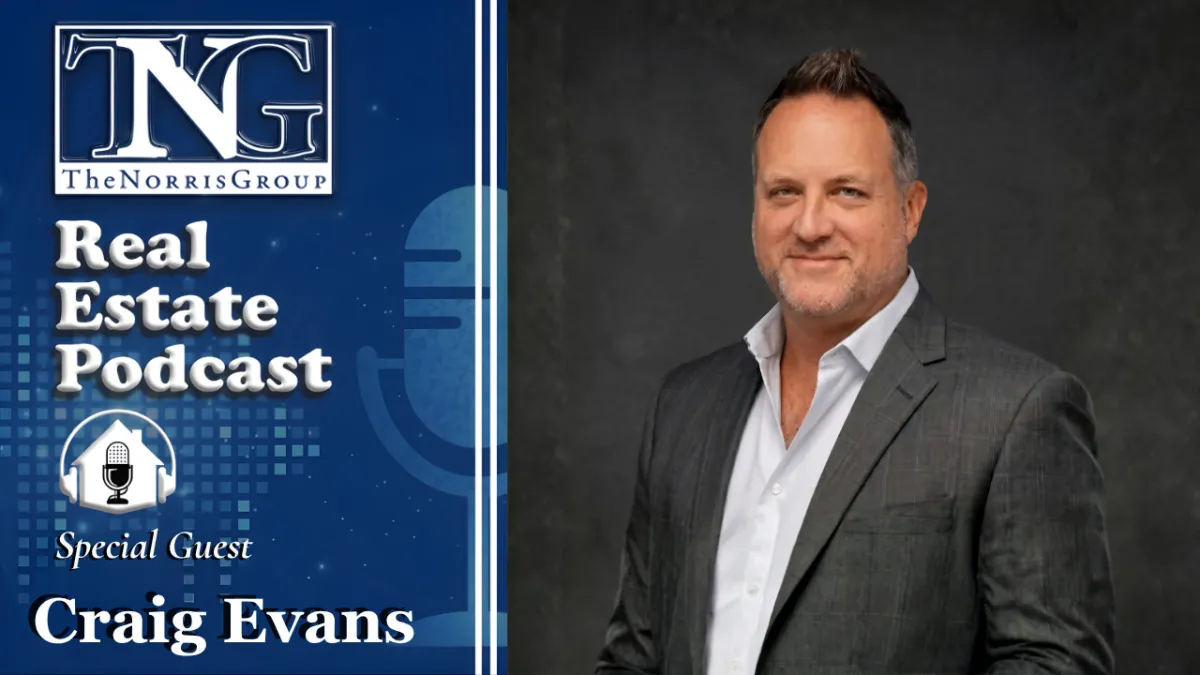
Building a Legacy with Craig Evans Part 2 #964
In Part 2 of The Norris Group Real Estate Podcast, Joey Romero continues his conversation with Craig Evans, CEO & Founder of DBL Capital, exploring how the company's investment fund is structured to protect investor capital while generating long-term growth. Craig explains how DBL Capital's disciplined approach to leverage, diversification, and capital deployment helps reduce risk while creating opportunities through affordable workforce housing.
Joey and Craig also discuss who passive real estate investing is best suited for, why workforce housing remains one of the strongest sectors in today's market, and how DBL Capital's focus on operational efficiency, faster build cycles, and strategic fund management positions the company for continued growth. Craig also shares his vision of helping more than 1,000 families achieve homeownership while delivering long-term value for investors.
Craig Evans is the CEO & Founder of DBL Capital and a Florida Licensed Building Contractor (CBC# 1262104) with nearly 30 years of construction experience across residential, commercial, and municipal projects. A third-generation builder, Craig founded DBL Capital to transform decades of construction expertise into a vertically integrated real estate investment platform focused on workforce housing, investor protection, and creating a lasting legacy through thoughtful development and responsible stewardship.
In this episode:
When investors begin earning returns after investing.
How DBL Capital protects investor capital with conservative leverage.
Why workforce housing continues to outperform in today's market.
The power of diversification across multiple real estate projects.
Who passive real estate investing is best suited for.
The company's mission to help over 1,000 families find affordable housing.
Craig's outlook on the real estate market and what's ahead for DBL Capital.
Episode
Narrator
Welcome to the Norris Group Real Estate Podcast, a show committed to bringing you insights from thought leaders shaping the real estate industry. In each episode, we'll dive into conversations with industry experts and local insiders, all aimed at helping you thrive in an ever-changing real estate market, continuing the legacy that Bruce Norris created, sharing valuable knowledge and empowering you on your real estate journey. Whether you're a seasoned pro or a newcomer, this is your go-to source for insider tips, market trends, and success strategies.
Joey Romero
Welcome back to part two of our interview with DBL Capital CEO Craig Evans. Let's get to it. All right. So one of the most important questions is how soon after capital is deployed can they start earning? So how how quickly can you deploy money, and when does that start my clock?
Craig Evans
Yeah. So so once they once an investor actually places money, you know, because you know there's a process of once you start the conversations and you get paperwork signed. It's it can be days to weeks before you know before this can take place. In the aspect of getting the paperwork signed, getting everybody accredited, it's not a hard process. It's very easy, but sometimes people, you know, take a few days to respond versus some people respond in hours. You know, so it's just the aspect of how quickly people respond. But once they actually place their money, once once they wire money into the account, it is typically a 30 to 40-five day time period before that money is mobilized. Now that doesn't mean that all of it's mobilized, right? And and again, we're different in the fact that a lot of funds will say, "Hey, you don't start earning until all your money has been mobilized. So in a syndicate, you may you may pledge a certain amount of money, and you may put in a certain amount of your pledge up front, but until all of that has been allocated, you're not even earning at that point. We're different in what we do in the aspect of basically our structure is as soon as we mobilize the first dime of someone's money, the first penny of someone's money, they're considered fully mobilized. We typically allow 30 to 45 days. We've had that happen as soon as two or three days. We've had it happen in like 46, 47 days, right? But but typically, we we tell people that that standard time is typically around 30 to 40-five days to mobilize someone's money. Now, again, as soon as one penny of their money has been mobilized, doesn't matter whether we mobilize all of it or not. As soon as one penny is mobilized, they're fully earning at that point. In other words, they're fully invested into the fund, and the fund is now diversified across all of the holdings, not just forward movement. So it's everything that the fund owns at that point. They're bought in at the evaluation of that process, almost like a a stock, so to speak. You know, but they they own they own throughout the whole company, not just what's forward moving, and that's a big key because, like I say, as soon as they're as soon as they're mobilized inside the fund. At that point, they're fully earning in all of the backwards pipeline as well as the forward pipeline.
Joey Romero
Okay, so let's say let's say I I put in my 250 and you mobilize my money august 1. So I gotta wait till August 1 to get paid again.
Craig Evans
No, so we're on an annual budget. So basically, the way everything works in our fund is, you know, we're we're January to december 31 time frame. So everything we do in that is, you know, calendar year, everything's up, and so whatever you would have earned from that August through December timeframe, that's what you would be paid on from a pro rata portion of what the fund made in profits that year.
Joey Romero
You already talked a little bit about the regulation that and the protection that being a 500 6c Reg D gives investors. But one of the questions I always get when people are asking me about DBL Capital. It's like, well, how much leverage do you use? And so, can you talk about leverage both individually for projects and as a fund in general?
Craig Evans
Yeah. So that's one of the things that I really spent a lot of time working through and working the numbers on and making sure that I built into our fund docs again protection because you know I go back a lot of people ask me as a fund manager remember I talked about this earlier you know that my priorities are the important things in life now as a fund manager people say hey what's your what's your biggest focus as a. Fund manager, for me, it's always protecting the equity. We're never going to hit home runs 100 of the time, but if I protect the equity, I can always make more money. If we lose equity, it's harder to make money when you've lost the equity, right? So, for for me, it's always how do I protect the equity? So, in doing that, a lot of people, and it's it's that that has shifted a little bit over the last maybe year or so. But my focus has always been I don't want to be over leveraged, so I wrote our fund doc specifically, and this was one of the things that I specifically wrote in our aggregate leverage within the fund cannot be above 70% and I did that because you know that way we could have 30% price damage, and we're still at least breaking even. We haven't lost equity, and I think that's a crucial component: is is making sure that we're protecting equity. You know, so and and this is proof positive. If I'm if I'm leveraged at 80% and we have a 12% price damage like we had in 24 and 25 collectively, hey, I'm only eight points to the good here, right? For me to start making some ground, I've got to really achieve you know higher levels of appreciation on the current assets that we hold, and then really change our model going forward to make sure we're handling costs effectively. When we're at 70% you know we had 12% price damage. I'm only 18. I mean, I'm still got 18% equity left. We're not even close to our equity position yet, so we're in a very safe position. We did that on purpose. We structured it in a way that we intentionally wanted to be in that process. Now, does that mean that I cannot leverage any single item over 70% No, because again, when you read the fund docs, it's got to be 70% as an aggregate. So I can I can have things leveraged over 70% but I've got to make sure that in the fund as a whole, the aggregate of everything in the fund cannot be over 70% and and that's a crucial component there because you know when you're talking about some short-term products, some of that leverage may be a little bit higher at times because we if we know we're turning that inside a five or six-month period, sometimes the leverage may be a little higher on that. But again, as the aggregate, we've got to stay at 70% or lower.
Joey Romero
Yeah. So so what's the biggest risk that you manage?
Craig Evans
Really, you know, Joey, what I would say is, again, it's it's managing the equity, protecting that, and and I believe the the biggest aspect that we've got in our fund that helps to protect against you know losses, you know, because we we can't build in stop gaps. You know, we can't build in stop losses like you can in the stock market. You know, we can't build in. I can't short my home sales. You know, I can't do those things for for for hedging hedging our bets, so to speak. Right. So so how do we have the ability to to protect ourselves? The biggest thing that I see that helps us protect is the pipeline. Managing that pipeline from the speed in which we build, and having a forward pipeline going forward means that we've always got more product that we're working off of. Which at that point, that really takes us into a process to where you know we're managing. If we've got a certain sect of money and we're trying to only build, let's say, 10 houses, but I can take a little bit more money, and now we're able to manage 100 houses, fictitious numbers. But in doing that, everybody's now leveraged across more houses, which means our diversification is greater across more houses. And in that process, if I've got even, but even in the aspect of saying I got 10 houses, if we're if we're doing that, and two of those houses don't do well, and we just break even on them. As a fund, we're still winners. You know, if we take the $250,000 let's say we've got an investor that comes in and they're investing 250 and they're the only one in the fund. Realistically, we can build somewhere between four to five houses with that 250 being leveraged out, let's say four houses conservatively, right? So because again, I want to allow for we've got two that may not do well. So if we've built five and I turn that twice a year, that's giving us 10 houses. If I've got two that don't do well. He still had an 80% success rate, and you know when you start looking and you really dive into all the numbers, that still turns an 80-580-7% return to the fund. You know, and I try to be very, very careful there. Now, again, remember that's a gross return. That's not a that's not a payout because we've got fees, we've got return on equity. There's a lot of things that have to be paid out of that. You know, but to pay the the numbers that we're looking at, you know, we have to turn high numbers. And in real estate, I think that's one of the biggest things that people don't understand is those are the numbers that's really achievable, is to be able to turn really aggressive annual numbers because of the speed of operation. But but I think honestly, if I had to say, I think managing the biggest thing that we manage is managing the pipeline, managing that pipeline creates a diversification that overall lowers the risk, because the better pipeline we've got and the stronger pipeline we've got of workflow means that everybody's diversified across more products. So if one doesn't go well, it doesn't hurt the whole.
Joey Romero
Well, let's talk about that pipeline. There's some really good momentum happening right now with your pipeline, but and and for the last you know, since you've been the the owner of of the Norris Group, you we've always talked about pivots and being able to change your strategy was one of a middle market when you first, you know, started the fund, and you've you've now pivoted to the workforce housing like almost 100% full steam ahead, and there's just crazy numbers coming in from those. But so how is that different for investors who came in at the beginning of the fund and how invest how how is it different for investors that would come in right now?
Craig Evans
Well, so that's a that's a really good question. So the the starting you know a fund again has it has to be valued. There's a valuation placed on the fund at different points throughout time, and obviously we we determined what our starting valuation was, and and that's you know where that began. People that come in now, it's all based on the valuation of where the fund is at the current time. You know the the same money might not buy as much as the person that that bought in day one, but that's that that's the only fair process because we we I can't give the person that came in two years down the road the same valuation of the person that chose to come in with us day one, but they're still diversified across all of the assets. They're diversified across the same assets. It's just their fund basis may not be the same thing, but you know. So, so from an aspect of you know, I had somebody ask me this last week. Well, you know, with pricing and what's going on with the market, if you think the market's going to move, should I wait? Well, at the end of the day, passive investing in that process is completely different than than being an active investor and thinking, hey, maybe I want to wait on this set of market or this set of tools, or because I can get a better price six months from now than I can. At the end of the day, our valuation in the fund is not going backwards, right? So there's never a better time to to buy into the fund than now, or as soon as you do, because the valuation will never go. It won't be going backwards from where it is today. It will only grow higher as long as we do what we do and do it correctly. Our fund valuations will always increase, so we'll never hit a process to where hey, the fund is valued worse than it was last year, and we've done that strategically through the setup and the structure of our fund to make sure that we add plenty of room to grow to always protect the valuations and the equity.
Joey Romero
You know, one of those things that the market is different. DBL Home Mortgage being a part of the exit strategy is going to make things different for people. You you you talked about 98% occupancy in affordable markets. So what that means is, well, I'll just let you explain. What do you mean by that?
Craig Evans
Well, so you know, I'm going to go back and and I'll answer that and tie back into your prior question as well because as we as you were talking, it hit me. I didn't fully answer that because, you know, we did start out at building some houses that were in more of a middle-priced market, and I did that specifically because at that time when we started permitting and and working through the the deal flow and the pipeline, you. Things weren't as fast. The permitting still wasn't as fast. There was a lot of things that weren't moving like they are now. But in doing that, we also were looking at, hey, we want to build for a section of the market that was that was not rate sensitive, and and what we saw out of that was that while they weren't rate sensitive, they weren't maybe necessarily as savvy to what the market was telling them was going on, and so the market froze in that middle market. You know, and now we're seeing the the results of that. That you've got the top end of the market that's really doing well, the the the affordable side of the market, the workforce housing that's really doing well, and that middle market is still just kind of sluggish, right? It was just stuck for nine or 10 months. It was just complete a year maybe that it was just completely stuck. Now it's it's moving, but it's sluggish, you know, and they've had the biggest price damage in that middle market. We made the selective choice to go back to our roots to really what we started. We said, "Listen, we're not going to deviate from that process again inside our housing fund in the aspect of we're going to build affordable. We're going to build the best product that we can build for the lowest cost that we can build it to deliver a quality product to the market, and a fantastic return to our investors, and at the end of the day, everybody's happy if we do that job, and and that's part of why you know we're we're again inside the fund docs trying to determine what we're doing, trying to be very very specific in what we're going to achieve. That's why I don't want to. You know, I wrote it to where I can't just go deviate and do. You know, I can't go buy storage buildings inside this fund. I can't go buy commercial buildings inside this fund unless it's something we're going to use for our own personal gain. So, so there's a lot of things that we've written in there that puts kind of the that that that ties my hand so to speak, so I can't just go off and do anything. So it forces me to stay disciplined.
Joey Romero
So just to give people an idea, when you say affordable housing, that means a lot different over here in California. So what is the price point you're typically selling these homes for,
Craig Evans
you're correct because it'll mean the whole like our affordable housing here is completely different in California. Our affordable housing here is a lot is more expensive than somewhere like Georgia or South Carolina. You know, so yes, it is definitely from a micro market. You know, it is different than than the macro, right? So we've got to pay attention to that. But but realistically, the houses that we're looking at here are three to 315 as an affordable, you know, price point, and that's really where we're at. We we are working hard to try to drive that to get to a sub three number, and and I believe if we can get down to the 290s through our pricing structure and a negotiation with vendors and and our land basis and how we buy, if we can get down to a sub 290 you know our 290 sub 300 number, I believe we will really be able to start controlling a portion of the market that's just not there right now.
Joey Romero
That's crazy because we you just you just in your last segment you just said that somebody puts in 250 you're gonna buy you're gonna build five homes with that so I'm building you know five times you I'm building $1.5 million worth of homes with my 250 investment right
Craig Evans
right
Joey Romero
so somebody sitting on the sidelines what what what's your message for them?
Craig Evans
Well, you know, Joy, a fund structure is not for every investor, and I recognize that. You there are a lot of people that want to see it and feel it and touch it, and and that they want to go change the toilet paper themselves. They want to go repaint the wall themselves, and
Joey Romero
I like where you're going with this. So let's let's do the let's do who is it good for and who is it not good for? This
Craig Evans
is not a good strategy if you are one if you're somebody that has to touch that product every day. If if you want to see every aspect that's going on, if you want to pick out the light fixtures, and this isn't those subs.
Joey Romero
Yeah,
Craig Evans
this isn't a strategy for you, right? And that's okay. That's okay. You know, when I first started in real estate investing, you know, Joe, you know that background of mine. You know, we we had I had a group with another friend of mine, and we had over 1100 doors, and we managed and chose the subs and helped to vet the tenants and and now I was a lot younger then I was a lot younger then but you know we loved that and we we we we rode after that challenge. There was a lot of work there, you know. No, we we were very fortunate, made a lot of money, but there was a lot of work there. The so if if that's you and and that's your goal is to say, hey, I want to maximize every dime I can. This probably isn't the best, right? Because at some point you're paying for some sort of service, right? From a passive investing module, which is this is 100% passive investing. I'm not asking for anybody to come in and and be on my board of directors. I'm not asking for anybody to invest and come in and have to give me your expertise. This is you believe in what we're doing. You like the model of what we do. You like the business model of what we do. You like what we stand for, and what our vision is. You know, our big vision, Joey, is over the next five years. I want to see us affect over 1000 families for housing. That's that's my goal. I want to see us affect over 1000 families for housing. I believe we can beat that number sooner, but but I don't I don't ever I don't like to lose. I'm very competitive, and so I I want to set this up, you know. But but I want to see us affect 1000 families with their housing situation over the next five years. So if if you if you want to be passive and you like what we do and you like what we're about, then then we're a good fit for you, you know, because it really is for the person that says, "Hey, I want to diversify. I don't want to have all my eggs in one basket, but I've generated some wealth, and and I want to keep my money turning, and because oftentimes it's it's somebody that's developed wealth, and and they physically just don't have enough horsepower to keep their capital and their revenue turn or their capital turning now, because as a as an individual, you know you you've got one of two options. You can either be the active investor that's going to go out and you're going to find your own deals in real estate, or you can have somebody come to you that has a syndicated deal that's on on a property. And again, I'm not knocking syndicated deals. I'm not a huge fan of them when that's my sole source of revenue because I'm I'm I'm only strapped against that product, right? When I'm diversified against many many products, I like my chances there a lot better through the diversification. So so in that process, if you're if you like the diversification of that, if you like, if you've been someone that's made your money and you want to keep it running because you just physically don't have the horsepower to keep churning that many deals, and let's face it, if not, what's your other option? It's the it's the stock market, right? You you got to play in the market, and you know most vendors in that don't want to deal in alternative sources now with with self-directed IRAs, things like that. You can still invest, but what do you got to do? You you got to invest in something passive, or you got to go find your own deal again.
Craig Evans
So it really comes down to the things where we are best, then the the sector of the market of investors that we're best for is those that have either have so much cash they don't know what to do with, and they just want to start turning it and don't want to have to deal with it, or we're we're great for those that have made some wealth either through real estate or they're a doctor or a high net worth earner, and they just need someone to to turn their keep their capital earning for them, but they like the the physical space of real estate.
Joey Romero
Well, and and that's you know there's been a lot of people who are you know working for a long time and are still very successful doing that, you know. But there's also people that are like, man, I'm tired of this stuff like working that now. So one of the things I wanted to to point out is, you can't 1031 into the fund, but you can use self directed IRAs to invest in the fund.
Craig Evans
Correct. Yeah. So so to invest in the fund, you you can put your own cash in. You can use self-directed monies coming in. You cannot. You are correct in that. You cannot, you know, use a product 1031 and take that capital and invest into our fund. You can do that into a DST, which is a Delaware statutory trust. But we don't. I don't really do those. That's a whole different animal. They're very, very expensive to to work through. So we really don't do DSTs. But but it's the aspect of now. Once you're inside the fund, our fund has the availability to use 1030 One's as a tax strategy, so that is one of the tax strategies that we use and are that we will be using as our fund continues to move and grow through. But you can't 1031 into the fund. So it's either you got to be you got to have liquidity that you can put in, or you got to have self directed that you can use. You can use ESOP money if you want to. So there's things like that that you can do.
Joey Romero
So what's the what's the best way for people to get a hold of you or DBL Capital? The
Craig Evans
easiest way is go to dblcapital.com. You can book an exploratory call that they really that that gets in and it's checking to see, hey, are you accredited? Because there's many people that maybe just don't know if they're accredited or not. You know, we were, we were at the event in California a couple weeks ago, and I got to sit down with a lady that she she just didn't even know that she was accredited. She's sitting there telling me, "I'd love to be a part of your fund, but I'm not accredited. Well, we started going through a scenario, and she's she's blowing accreditation out of the water. You know, and she didn't even realize it. So, so you know the aspect of finding out, hey, am I even accredited? Is this something for me? Those types of questions or things. If they go to dblcapital.com and book that initial phone call, we can go through and start diving in and answering those questions, and we get them you know access to our data room to where they can get in and start seeing if they're credited. They can start seeing our fund docs and start reading, and then they'll like they'll get an appointment scheduled with me after that to really dive in and and answer questions even further to see if what we do and what we are is something that they believe in and want to be a part of.
Joey Romero
So, what's your final final thought for investors, and what are you excited about for the rest of this year.
Craig Evans
Well, for for the market as a whole, I'm really excited for what's happening with with affordable housing. We are seeing affordable housing really starting to move at a rate. It's not back to you know pre COVID or just after COVID days to where it was everything was moving off the shelf at an astronomical rate, but you know we're seeing affordable housing. If you're hitting your numbers, we're seeing housing moving in 30 to 40-five days. Those are those are good good times right now. They're stable times, and I think that's one of the things that's encouraging me. Is we're starting to see a lot more stability in the marketplace, especially in affordable housing, the affordable market is very, very stable right now. For the fund itself, I love our pipeline, the stuff that we've got coming, and also I will tell you, Joey, I'm very excited about our build cycles. We we made we brought on some new vendors that's really helping us and doing some things. Our management strategy. We've made some some pivotal shifts. That's helping us through some of the the last you know couple years of changes that we've seen in the market, and it is really driving down our our days of build cycle. So we're excited about that. A lot of great things are happening because obviously the faster we can build, the the more turns of a capital we can make within the fund, so we're super excited about that. But past that, honestly, Joey, we're excited about building more houses for people and affecting lives through housing. That's that's what we're excited about.
Joey Romero
Awesome. Well, thank you so much for jumping on with me this week. I know it's it's always easy talking. You know we do this stuff all the time, so it's it's easy talking about this kind of stuff. But I thought it would be helpful for a lot of the folks that you know just ask me just really general questions and wanted to put that out there. So thank you for joining me today.
Craig Evans
Absolutely, Joey. Thank you so much, man.
Thanks.
Narrator
For more information on hard money loans, trust deed investing, and upcoming events with the Norris Group. Check out thenorrisgroup.com for more information on passive investing through the DBL Capital Real Estate Investment Fund. Please visit dblcapital.com.
Joey Romero
The Norris Group originates and services loans in California under the California DRE license 01219911 Florida mortgage lender license 1577 and NMLS license 1623669 For more information on hard money lending, go to thenorrisgroup.com and click the hard money tab.