
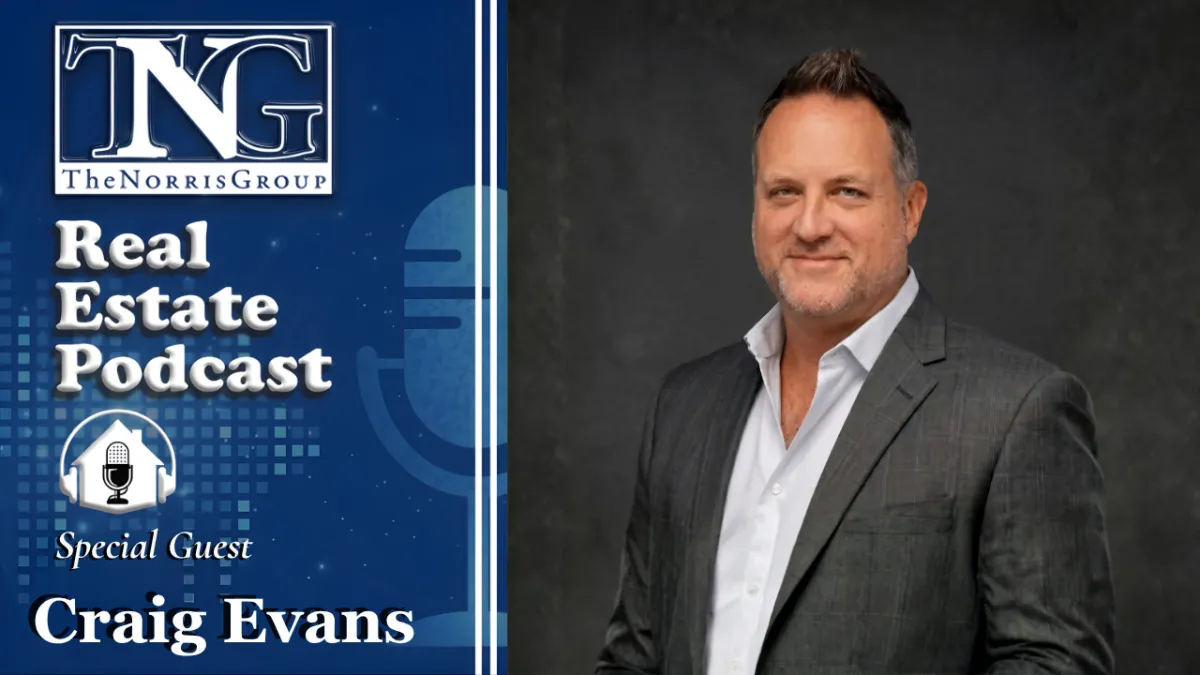
Building a Legacy with Craig Evans Part 1 #963
In this episode of The Norris Group Real Estate Podcast, Joey Romero is joined by Craig Evans, CEO & Founder of DBL Capital, for a conversation about leadership, affordable housing, and building a business rooted in faith, family, and stewardship. Craig shares the mission behind DBL Capital and explains why workforce housing has become the company's primary investment focus, highlighting the growing demand for affordable homes and the importance of protecting investor capital while creating long-term value.
Joey and Craig also discuss the advantages of DBL Capital's vertically integrated business model, including its homebuilding and mortgage companies, and how this approach helps deliver quality housing while improving affordability for homebuyers. Craig reflects on the lessons learned from navigating COVID-19, supply chain disruptions, hurricanes, and shifting real estate markets, while explaining how disciplined planning, multiple investment strategies, and strong partnerships have positioned the company for long-term success.
Craig Evans is the CEO & Founder of DBL Capital and a Florida Licensed Building Contractor (CBC# 1262104) with nearly 30 years of construction experience across residential, commercial, and municipal projects. A third-generation builder, Craig founded DBL Capital to transform decades of construction expertise into a vertically integrated real estate investment platform focused on workforce housing, investor protection, and creating a lasting legacy through thoughtful development and responsible stewardship.
In this episode:
The meaning behind DBL Capital and how faith, family, and legacy influence Craig Evans' leadership.
Why stewardship and serving others are central to the company's business philosophy.
The growing affordable housing shortage and why workforce housing is DBL Capital's primary investment focus.
How infill construction creates opportunities that many institutional investors overlook.
The advantages of owning an integrated homebuilding and mortgage platform.
Lessons learned from navigating COVID-19 disruptions, supply chain challenges, and multiple Florida hurricanes.
How strong relationships with trade partners helped the company overcome difficult market conditions.
Why affordable housing has remained resilient through changing real estate cycles.
How DBL Capital's fund structure provides flexibility, multiple exit strategies, and added protection for investors.
The role of tax strategies, depreciation, and long-term planning in maximizing investor value.
Episode
Narrator
Estate Podcast, a show committed to bringing you insights from thought leaders shaping the real estate industry. In each episode, we'll dive into conversations with industry experts and local insiders, all aimed at helping you thrive in an ever-changing real estate market, continuing the legacy that Bruce Norris created, sharing valuable knowledge and empowering you on your real estate journey, whether you're a seasoned pro or a newcomer. This is your go-to source for insider tips, market trends, and success strategies.
Joey Romero
All right, welcome everybody to the Norris Group Real Estate Podcast. We have a special familiar guest, sort of. So today we have as our guest is Craig Evans, CEO of not only the Norris Group, but today he's here as CEO of DBL Capital, because there's some exciting things happening in the fund, and we just wanted to highlight it, kind of, you know, we were just throwing this around, and like, man, that was a really good meeting we had a couple weeks ago with the investors. We had a private, a private dinner, and some great conversations, and just some things, even that I didn't know was happening. So, it was really cool. So, but before we get into what the funds doing, Greg, how you doing today?
Craig Evans
Good, man. Very good. It's good to see you. You know, it's been very busy with my family and everything going on, but it is good to sit down and chat with you today.
Craig Evans
All right, so now the first thing, first word out of your mouth is family. So, actually, DBL Capital, and everything you do is framed around family. Tell me, why that's so important to you.
Craig Evans
Well, you know, a lot of people don't really understand where what the DBL stands for, and it's Douglas Brooke Legacy, and so Douglas is actually my middle name, Brooke is my wife's middle name, and Legacy is all about the legacy we leave behind, you know, we can, we can make money, we can do a lot of things, but to me the important thing is what what legacy do we really leave in this world, and that's that's my big goal, as we're working through and developing the companies that we do, is how do we leave this world behind us. So that means a lot to me.
Joey Romero
Now, one of the things is that, and a lot of people kind of, not that they hide it, or they just, you know, they wait until it's a comfortable setting, but not for you. Faith, faith plays a big part of you in your personal life, and you don't shy away from it in business. So, can you talk about that a little bit?
Craig Evans
Yeah, you know, Joe, we talked about this a little bit before the meeting out in California. You know, I've actually had some friends that tell me, hey, you need to tone back your rhetoric, and this talking about your faith, you know, and I actually started to consider and think about that, and I just was ready to, you know, I was disappointed in myself that I was even willing to consider that, you know, and so, you know, at the last event, you know, I, as always, I'm unashamed about it. I'm gonna, I'm gonna talk about what I believe. I mean, my faith means more to me than anything. I know the life that can be pushed on us and the challenges that can come, and I know without my faith in Jesus Christ, I know I'm in a rough spot, you know, and, and we talked about it a little bit that night. Everything I do really bases on or spins off of three three priorities. I really try to focus on what's the priorities in life, and my number one priority is always, and always will be, my faith in Jesus Christ, you know, how do I live my life? I don't beat people over the head with it, but I really work hard and try to live the life of saying, you know, God helped me to be a better man tomorrow than I am today. How do I make better decisions and live a life that pleases God more than what I did yesterday? My second priority is always, and always will be, my wife, Stephanie. Again, Stephanie Brooke, she's the Brooke of Douglas Brooke, but you know, my wife is always my second priority. I love my children, but my wife will always be my highest priority above my children. I chose her first, and she chose me, but then my third priority is my children. You know, I've got Georgia and Addison, you know them both well. And I love my girls. I'm so proud of seeing what they do. And Georgia's in college in North Carolina, and you know, working on her music degree. Addison has just graduated from high school and about to start at USF, and her business degree, looking at finance. She's looking at coming on with us. So, I'm super excited about my family, but you know, Joey, the thing that that people talk to me about and ask me, you know, like when I talk about these things, they said, "What, you didn't talk about your business? My business isn't my legacy. You know, the business isn't who I am. That doesn't, that doesn't determine who I am as a man and what I leave behind. Those are just tools that I believe God gives us to be a steward within this world. My, what I've been given stewardship over is my wife and my family to be able to try to lead the best I can with all my faults and failures as an individual to still try to be a leader that makes them proud and that makes other people proud of the legacy we're trying to leave.
Joey Romero
Well, a lot of those qualities translate when you're talking about being the CEO of somebody of something, you're talking about being the fund manager and taking those that stewardship, you know, that core belief that you have in being a steward for other people and being of service, where you know you're you're like a dog on a bone, just protecting that, that equity, protecting people's money, and protecting their legacy that they're trying to build.
Craig Evans
Well, and you know several people have asked me, you know, what is my number one thing that I strive for in business, and you know every business has a different value, as far as what are we trying to achieve. You know, as a fund manager, obviously, you know, I've got a goal of trying to deliver fantastic value to our investors, to deliver safety to our investors, protect their equity, all of those processes. As a builder, you know, we've got to be a good operator and build timely and build quality product, you know, all of those aspects. But at the end of the day, you know, when I turn around and I look and I say, hey, you know, really, what what makes us as a company, it's how well do we serve others, you know. And for me, as a CEO, I'm not the one building the house, right? I'm not the one doing all the things. So, for me as a CEO, really, I have to look at it and how do I serve those that choose to work for us and work with us. How do I serve them? And I believe that the better, the more I can be a servant to other people, that helps in that aspect of me being able to provide that. And then, as a company, we are are better servants to others and produce better products.
Joey Romero
One of the biggest talking points in the country right now is affordability, and and the crisis that that we're going through as a country, and people just not being able to afford homes. You cite in your presentation that there's 21 million families that are spending more than half of their income on housing, and that there's 7 million. There's a shortfall of 7 million homes in that price point of affordability and affordability, affordable homes. So, walk us through why workforce housing is not just as the opportunity for you, but just not just as an opportunity, it's like the one that you're going to focus on, and everything that that DBL Capital is focusing on right now.
Craig Evans
Well, to me it's where, where again, where do I place my values, you know? And you know, I think a lot of that goes back to my history, you know. Joey, I've built a lot of, I've been a part of building a lot of big structures and a lot of expensive buildings and expensive homes, and, and those are all, you know, they're good egos that you, they're fun to brag about, and you know, the atta boy, you pat yourself on the back, because, wow, I did that, but at the end of the day, most of that's just $1 sign to somebody else. I part of why we look at the affordable housing is, you know, as a builder, when we get Christmas cards at Christmas time of people that have just been able to come out of an apartment and have their first Christmas in their own house, that's a big thing for us, you know. We love when we get those. Do we get them every day? No. Listen, I mean, we don't sit around and sing Kumbaya, and you know this is work, and people have lives to live, but the knowledge of knowing that we're providing a product that is so needed because of the affordable nature in our, in our country right now, you know, you mentioned it, and it's on some of our data and stuff, you know, there's about 84 million families. Well, over 21 million of those are spending 50% of their revenue, their annual revenue. Over 50% of their revenue is going to pay for housing. It's no wonder that families are living week to week trying to figure out how to make it through when 25% of the country is saying, hey, we're spending over half of what we make just to have a roof over our head. I think we can do better than that. I think we can be better than that. It takes effort. It's hard work to work the pricing like you have to do. It's. Hard work to to beat the times and to operate on the schedules that we attempt to work off of, and it is a lot of work to do that, but I think there's great value in that. I think you know, you asked me, why did I choose this as a fund for our fund? You know, there's a lot of class A projects, there's a lot of high-end, you know, luxury product that we could go build, and maybe we get a better yield if we hit right, you know, but there's a couple things there. One is, if you look back through history, affordability and affordable housing has always, always been a seller. There's always a buyer that needs affordable housing, that's not going out of style anytime soon. You know, I mean, let's look at what's happened over our 24 and 25 You know, we've reached appreciation in this country and appreciation levels to where the markets just couldn't sustain that, even at middle price points and higher end price points, and we've had in some markets, you know, 1012, even more percent of price damage, right, on some of those higher end stuff. When you look at where affordable housing is, we've had appreciation, but we really haven't lost back in that, so affordability sustains typically sustains its pricing model, you know, as long as the neighborhoods that you're building in, and everything, as long as they're sustaining in their schools, as long as the crime model is not getting out of control and going crazy, it's a process that affordability is always a winner, so that's that's really why we look at it. We look at it from one, from $1 and cents perspective, it's always a winner. Two, it is, it is a, it's a thing that is needed so badly in our country, and quite frankly, it's a lot more fun to see the smile on somebody's face when, when they know they've just gotten their first home,
Joey Romero
so you, you, you call the infield construction messy and slow to scale. Why does that scare off the big players? But how does it actually work for you?
Craig Evans
Yeah, you know, I'm, I'm, let's say I'm over 35 years of history in construction, and, and most of my residential experience has been all infill, and you know the difference between infill and, you know, community development and construction. Community development is a lot easier to build in, you can scale at that now. The timing on that can take play, you know, or take, you know, have it have an aspect of how you deal with that from a turn of capital, but because you can have a year and a half, two years of pre development before you ever get to start breaking ground and going vertical, you know, and starting to build vertical on the homes, so there's a cost factor there that you got to take into play, you know. Obviously, as our fund continues to grow and the cash flow the fund allows, that we will start to develop in communities as well. But from the aspect of under, if you really understand how to build infill, it is a niche that most institutional level funds don't look at, because it is exactly that - it's messy. You got to know what you're looking for, you got to know how to manage through entitlements, you got to know how to manage through permitting, and it takes an expertise and a knowledge that most companies just don't have. There's been a few that's been somewhat successful in it, but it is. It is a harder process to manage, and so that's why a lot of builders really prefer going and building in a community, because it's just easier.
Joey Romero
So most funds are going to go and try to acquire existing assets, you know, existing companies, existing buildings, existing departments. You're building from the ground up, and you're affecting the shortage by doing so, but how does what does that distinction matter with your returns?
Craig Evans
Oh, well, the biggest aspect is one, you're able to get a brand new product with virtually no capex needed for the next, let's call it five to seven years, right, but the biggest aspect in doing that, we now get that at a truly wholesale rate, you know, most companies, when they're buying, they're just, you know, Douglas Brooke, our home builder, has been approached by several institutional funds to build, and, and in that aspect, you know what they are willing to pay is typically is a higher number than than what we then what Douglas Brooke are within what DBL. Pays Douglas Brook Homes. Now we do that specifically for a reason, and we've kind of geared ourselves to where you know, for the most part, Douglas Brook Homes, our home builder, only builds for DBO Capital. Now we have a few investors that we build for on a private side, but for the most part, Douglas Brook Homes only builds for DBO Capital, you know, so, so, in that aspect, we're able to manage through those costs. We don't subsidize the costs. DBL Douglassburg Home still has to stand on its own, but, but in managing through the numbers of that, you know, we're able to deliver a lower cost product by staying streamlined and running lean, and again, knowing the markets right, if we try to go go into markets too quickly and don't understand the market, we've, we've had scenarios where that didn't work well, you know. And so that's some of the things I've had to learn through life, is you know, you've really got to understand your markets before you start trying to go horizontal and vertical in them, one
Joey Romero
of the newest, and a lot of people don't know about this, in your vertical stack is, is couldn't kind of be your secret weapon, is DBL Home Mortgage. How does that create an advantage, you know, when you're going to exit some of these affordable homes?
Craig Evans
Yeah, so DBL Home Mortgage, we are super excited about that. That is going.. it's been a great model for us, and in that, when we're able to offer rates that other people can't, before buy downs, anything like that, you know. Now we're able to come in and literally help people buy their houses. For instance, last Wednesday, we had a young man that was moving down from Jacksonville, needed a house, looking to buy a house, and you know, we said, well, listen, if you're going in and use our mortgage company, DBL Home Mortgage, if you use our mortgage company, we can get you things that others can't, we're able to help you with some concessions, some closing costs, things like that, so we started working through, and what we started seeing was, you know, he made plenty of money on and on and on, but his debt to income was still affected, because he had some debts out there that really he could affect pretty quickly, just because he had some cash laying around, so not only were we able by far beating the every rate he was getting by over half a point. I mean, we were beating everybody's rates that he was seeing so far over half a point, which allowed us then to be able to say, okay, now we can work in and do more concessions for him, which helped him get into the house, and on top of that, our processors, our agents that are working on the loan closings were able to help him work through his debt scenario to clean up some of the debt that actually even got him down almost another full quarter of a point than what we'd originally quoted him, so having that in our pocket was has been extremely beneficial at being able to get product moving and making sure that we can always provide the best product at the best price, and that's a lot of what we're trying to do, is when we talk about affordability, the price may be good, but if the person can't afford the monthly payment, that's that's the problem,
Joey Romero
so you've done over 100 million projects in projects through multiple market cycles, you, you were a builder through, through Ian, and then you know you continue building after that. What is what has been the one thing over your career of building that has tested your model the most?
Craig Evans
I would say without a shadow of a doubt, those two years, back to back years of Ian, and then right after that, Helene and Milton, those two years were some of the most trying years that I've ever seen as a builder, you know, and especially because we're our headquarters is down in southwest Florida. At that time, we were spread into four markets. We were in two states, and we got pounded in both states by both storms. It was a rough, rough time to be a company the size that we are, right, we're not a Lenore, we're not a Dr. Horton, so as a company that's for our size, which we were growing extremely fast, 2022 we were listed as the 10th fastest growing contractor in the entire country, and that's got its own ups and downs and challenges and everything, but with that growth that happened right at the time that that Ian hit, and then Helene and Milton hit the next year, and we went from where you know one of the fastest growing contractors in the country to now nobody can get block, nobody can get trusses, nobody could get anything, you know, we're. We go from I'm getting trusses in three days to now I'm getting trusses in 12 to 14 months. You know, that
Joey Romero
was that was coming on the heels of all the disruption from Covid.
Craig Evans
All of that came through, you know, and you know there's a lot of sectors in the market in the country where you know everything is stick built, where it's all wood frame, you know, wood frame construction, and because of the windborne storms and things that we get down in southwest Florida, you know, most everything here is built out of concrete block, you know, and it's the cells have steel in them and they're poured with cement, and and it was down to so many things transpiring that we couldn't even get the fly ash to make for the plants to make concrete coming out of Covid, so that's one of the things that slowed it down. So, obviously, the costs were an animal at that point that that everybody was dealing with, but but in the process of our cycle times and budgeting, that you know, we were a very fast builder, pre-COVID, extremely fast, you know. We went to after COVID, we were 12 to 13 months, where, but for us that was just demoralizing, but you know, we would also then turn around and look and say, okay, well, hey, we got national builders that are building in 21 months, so we were still delivering far below where other builders were delivering at the time, so while it was one of the most difficult times ever to build through, it was a time that I'm proud to say we built through, and it was the time that we survived through that. You know, Joe, you know, me and my dad are like, we're like best friends. I love my father, you know. And I never forget, I was taking my dad to lunch one day, and he just looked at me, he said, "Greg, he said, "you know, I've been building since I was 18 years old, you know, he's 82 this year, so at that time he would have been 7879 and he's literally looking at me, says, "If I had to go through anything like your goats are going through right now, he said, "I'd have never been in this business. It was just insane. It was crazy, but at the same time, Joey, I'm grateful, because when you go through hard times, you figure out who you are and you start knowing what you can achieve, and so, as hard as those years were of going through those two storms, not just what it did physically to the people that work for us, and their homes, and your communities, and seeing what people have to deal with, but how do you then keep a business flowing when you've got, you know, investors to respond to, when you've got developers to respond to when you've got trade partners to respond to, and then when you've got the people that come in your office every day that are working for you, and they're saying, "Hey, we want to produce all this, but I haven't had power in three weeks. You know that those were tough times to work through, but man, I'm glad that we, as we come through that, we know who we are.
Joey Romero
Well, and that's one of the things that people don't understand. They see a Lennar, and they're like, "Oh, well, they just handle everything from A to Z. They see, so they think every builder's like that, you know? You're talking about over 150 you know, trade partners that you have to deal with to make all this magic happen, right? And as we were talking about this before, that could be a double-edged sword, you know. Sometimes the, there's some trade partners that you got to be a little tough on, and then sometimes the trade partners that will absolutely lift you up, right.
Craig Evans
Yeah, we, you know, the 24 and 25 I would look at and say, while, while the times of, let's call it 2020 when Covid hit, up through about 23 when we're coming out of all the storms and the hurricanes and everything that happened, those were extremely hard times, right, but those were hard times, just as people, and because you're trying to figure out how this is working in life, right, because there's so many nuances that were new to the world, right. There was things that had never really happened before. Then all of a sudden you get into 24 and 25 and especially into 25 and let's face it, I mean, we're talking about the real estate market did things comparable to 2008 now not as bad, but you know, we had price damages in some markets of the country, 12 and 14% those were price damages that nobody saw coming, you know, 22 and 23 while it wasn't hot like it was in 21 and 22 the market was still very, was still somewhat climbing, and and just an easy, steady climb, if not plateauing a little bit. I don't think anyone saw what happened starting in 2024 when the uncertainty of the markets due to inflation, and it was happening so quickly, there was so. Many markets, and so many sections of the market, they just really didn't know how to read that. So, in that process, you had a lot of trades, you know, different skill sets that were just grabbing work wherever they could grab, and all of a sudden you're going from a trade that shows up for you every day to now all of a sudden they're telling you, hey, we'll be there when we can, but they've already started your jobs, and while they're the contractor of record, and you're trying to work through that, because you'd have longer to change a contractor of record than you would to work it out and work through it with them, but yet the one you'd worked it out with had already gone and grabbed 20 other jobs, and and they were just starting them all to get them on the books. Now, the flip side of that is, you know, so obviously we had some trades that were, and that's a part of construction, but we had some trades during that time that were could have been a detriment to us, you know, to a lot of builders it would have been a detriment to, but on the flip side of that, we have a lot of trades that looked at it and said, wait a minute, we're all in this together, let's figure out how to work through these trying times, right, and and a lot of them have come back with with pricing, with better service models, with things that said, hey, we want to be a part of the success of these companies like Douglas Brooke Homes and DBL Capital, they understand what we're trying to achieve, and quite frankly, they all know our model of what we're looking at as affordable housing, and that's why we have a lot of the trades that we have right now, is because they are passionate and love the fact of what we're building, just like we are,
Joey Romero
so let's, let's talk about that a little bit. Where things are in 2026 we've already talked about how 25 was really tough, but now you did build some homes, and and it's interesting that some of them you sold and some of them you kept, and so how did that, you know, how did you, you know, make that pivot on the fly, and how did that work out for the fund and the investors in the fund?
Craig Evans
Yeah, so in that process, you know, I will say this, but in answering that question, a lot of the reason, not a lot, the main reason that we ended 2025 and came in at 26 like we did, is because of the structure that we set up within the fund. So, when you read our PPM, when you read our fund docs, and you read our operating agreement, you know a lot of people look at it, and it's just.. it's 100 and I don't know, 20 pages or so on a ppm, and
Joey Romero
it's riveting. It's, yeah,
Craig Evans
it's some of the.. it's some of the best. I always tell people it's some of the best bathroom reading you'll ever have, you know. But it's in that process, you know. We spent a lot of time at developing how the fund will operate, and I was very intentional about that, because there's a lot of companies that, when they start their fund, that they're just running out, and they, they just want to get it going as fast as possible, so they get their docs put together, they don't spend a lot of time at really looking at what is the docs going to do for how you operate, because in a fund, everything is based on how, what do your fund docs say we have to go off that right? So, in that process, setting up our structure the way we've structured it provides a lot of security and protection for the investors, but it also does that because it gives me, as the fund manager, a lot of options of how I can move through and protect people by I can chew, you know, I've got multiple exit strategies, I've got multiple hold strategies available to us because of the way we wrote the docs, I've got a lot of limitations put on me, so I can't just go off and do anything we want, so in that it really allowed me and started saying, wait a minute, because of how our fund is set up, we can structure this to be available for 1031 exchanges, so in doing that, holding them and now selling a lot of these off that we've chosen to hold into the 1031 market has been a very valuable process for the fund, and it's providing a great source of doors, if you want to call it, you know, for for people that need to do 1030 ones, you know, so it's, and it's giving them good cap rates. So, in doing that, that's really I base all of that all back to the structure of the fund and how we've set it up.
Joey Romero
Well, and the one thing that that people don't understand is that the way the fund docs are set up, in the way you've set up, you're able to get some massive depreciation, because you know everybody talks about the best way to do that is to, you know, cost segregate well, because you're a builder, you know exactly. Exactly, what to segregate, so can you tell, talk a little bit about how you created some, some really good depreciation form.
Narrator
For more information on hard money loans, trust deed investing, and upcoming events with the Norris Group. Check out the Norris group.com for more information on passive investing through the DBL Capital Real Estate Investment Fund. Please visit DBL capital.com
Joey Romero
The Norris Group originates and services loans in California and Florida under the California DRE license 01219911 1219911 Florida mortgage lender license 1577 and NMLS license 1623669 For more information on hard money lending, go to the Norris group.com and click the hard money tab.