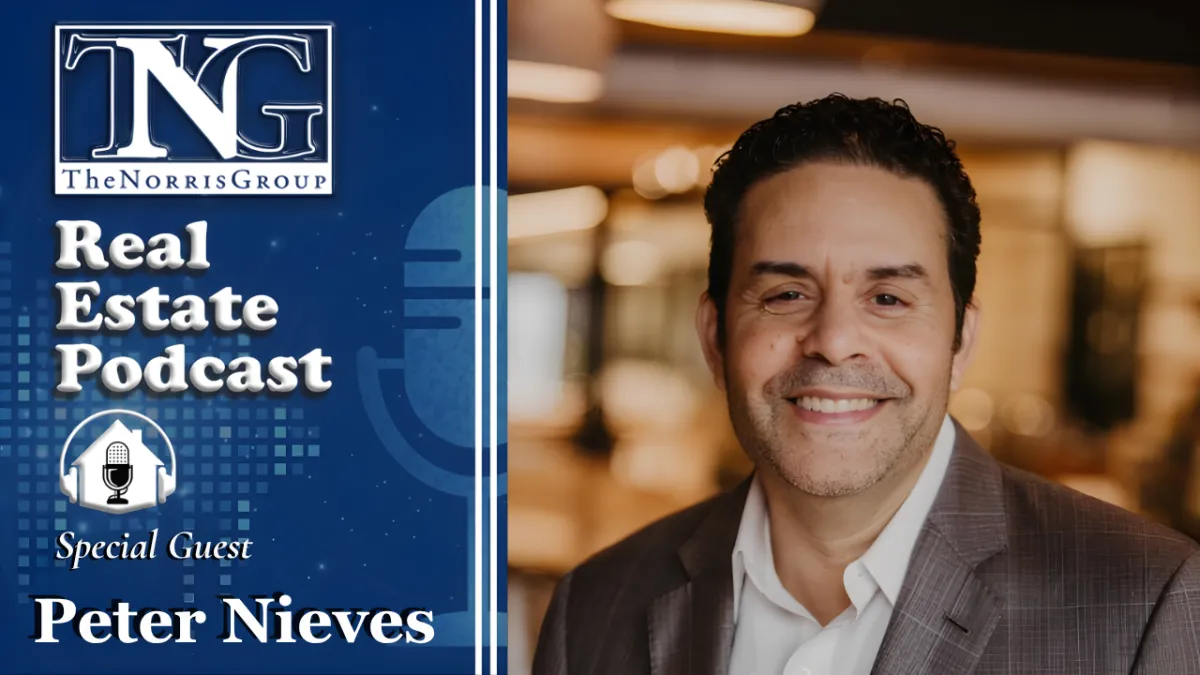
AI, Intellectual Property & Business Protection with Peter Nieves Part 2 #962
In Part 2 of this episode of The Norris Group Real Estate Podcast, Joey Romero continues his conversation with Peter Nieves, Founder of Nieves Intellectual Property Law Group, exploring the legal and business implications of artificial intelligence. The discussion focuses on AI agents, data privacy, business liability, intellectual property rights, and the risks associated with integrating AI into daily operations.
Joey and Peter examine who owns AI-generated content, the legal challenges surrounding AI training data, copyright and patent considerations, and the potential exposure businesses face when using AI systems. Peter also shares practical strategies for implementing AI responsibly, protecting confidential information, and leveraging AI-powered tools to improve efficiency while minimizing legal and intellectual property risks.
Peter Nieves is a nationally recognized Intellectual Property Attorney, AI Legal Strategist, and speaker known as “The AI Legal Authority.” With decades of experience in trademarks, copyrights, patents, trade secrets, and global IP strategy, he advises businesses on protecting their intellectual property while leveraging AI for growth. Peter has been recognized as Lawyer of the Year in Intellectual Property Law, ranked by Chambers USA for Intellectual Property, named a Super Lawyer in IP Law, and is a former adjunct professor of Intellectual Property Law.
In this episode:
What AI agents are and how they differ from traditional AI tools.
The legal risks of AI-powered automation, including privacy, confidentiality, and liability concerns.
Who owns AI-generated content and why copyright protection remains a challenge.
Data scraping, AI training models, and the lawsuits shaping the future of AI.
How businesses can protect confidential information when using AI tools.
Practical ways to leverage AI safely while minimizing legal exposure.
Patent, trademark, copyright, and trade secret considerations for AI-driven businesses.
Key intellectual property mistakes entrepreneurs should avoid when building AI-powered systems.
Why professionals who learn to use AI effectively will have a competitive advantage.
Episode
Narrator
Welcome to the Norris Group Real Estate Podcast, a show committed to bringing you insights from thought leaders shaping the real estate industry. In each episode, we'll dive into conversations with industry experts and local insiders, all aimed at helping you thrive in an ever-changing real estate market, continuing the legacy that Bruce Norris created, sharing valuable knowledge and empowering you on your real estate journey. Whether you're a seasoned pro or a newcomer, this is your go-to source for insider tips, market trends, and success strategies.
Joey Romero
Welcome back to part two of our interview with Peter Nieves. Let's get to it. All right, let's take it. Let's take it to the next level of risk, agentic AI. So, all right, so what exactly is an AI agent, and how does that create a unique legal problem compared to just using the AI tools?
Peter Nieves
All right, we're going to simplify this, because we don't want this to be like just kind of blowing people's brains up, so we're going to make this very simple. Imagine you could actually enter into your Outlook platform, or your document management software, some kind of software agent, right, which is really software that now has the ability to go through all of your content, become familiar with it, train its own model, so that now you can prompt and you can get results. Imagine that, like, so let's say you go into, as opposed to doing a word search in Outlook, I can go and say, "Hey, and let's say I name, I can actually name this, this agent. So let's say you go in and you say, "Hey, Steve, this is what I want you to do. I want you to look through the last four years of email communications. I want you to summarize every potential client where somebody used terminology saying that they were looking for legal support, and I want you to do xyz with it, like it will within seconds give you not only the emails back but a summary of who the parties are, their contact information, their phone numbers, their email address. Like, I mean, it makes your life so much easier. It's remarkable. However, sounds great. Every everything I say is, however, I feel bad now. So everybody right now is just drooling, going, 'Oh my gosh, I want that. All right, here's the problem. A number of these agents that are being created by people who are being hired, what they really are are APIs or graphical user interfaces that are back ending into like Open AI's Chat GPT, right. Why is that a big deal? Because many of these platforms are collecting and learning from the information that you're utilizing, so the problem is that if you're not using a closed system, if you're not using an agent that is not training the model, if you're not using a system that is not going to take your content and give it to another party, you can run into violations, not disclosure agreements, HIPAA violations, if there's any medical information, I mean, you just name it, ethical violations, there's so many issues that are happening right now.
Joey Romero
Yeah, let me ask this question. You know, okay? So you have the train, you put the, you put guardrails in, but it still, it executes a command or it sends an email, and now that does harm to somebody else who's liable.
Peter Nieves
So say that last part again.
Joey Romero
So now it actually harms somebody. So the email, the email that you sent, you know, created harm on the other end of that. So, who's liable now?
Peter Nieves
At the end of the day, you and look, this is not legal advice. All right, go talk to your lawyers out there. You know, attorney, you have us didn't tell you do this or don't do that. But in general, if you're using an app on your behalf of your company, essentially is acting like an agent, and you become liable for what's actually being performed, right? So, just like any software platform, if you have software acting on your behalf to perform certain functions, and somebody gets harmed, it's reasonable to go after the party who actually is providing that service. Okay, now just we've talked about all the negatives. Let me talk about the positives for a second here. Okay, sure. So, if I hire, when I hire a party to create an agent for me, I say to them, look, I want a closed system. I do not want the model being trained on the content that I'm using. I have to make sure none of my content is going to a third party, that agent is located on my system or my server, or if it's on your server, it's a closed system, it's it's protected, it's not being shared with third parties in any way, shape or form, if I do those kind of things, I've got a powerful tool that is going. Make my life exponentially easier. I'll give you one example. Last week I had a major corporation reach out to me, and they wanted to do a legal agreement that most people have never heard of. Right, it's an obscure area of the law associated with intellectual property law. I use open claw, right, but when I use Openclaw, I do not put anything personal in it. I do not have it on my local PC. I have it at a remote location, right? So, there's no way that thing has access to my client information, my information, billing of nothing. It only eats. It's like the Tasmanian devil locked in the void somewhere, and I feed it when I want to feed it. Okay, so now what I did was, I told it, I want you to go to United States Patent Trademark Office. I want you to look up this specific statute. I want you to learn everything about it. It learned that within 15 seconds. Then I said, I want you to now look up this exception to the rule that I just told you to learn about, it's called such and such. I want you to look it up, look it up on the USPTO website, and learn everything it is about it. Tell me when you're done. 15 seconds, I don't even think it was that long. Done. I said, okay. Now I want you to look up every, every court case, every federal district court case talking about that exception to the law, and I want you to learn it. Took like three minutes, and it was done. Okay, now that you know this, I'm going to upload one of my legal agreements without the party names on it, and I want you to modify this legal agreement to focus on that body of law for that exception to the law, and I want you to provide for me a legal agreement for client ABC. I literally called them ABC, Joey. Two seconds, dude. Dude, this thing would have taken three, four hours to create. Two seconds, this thing spits out in a document that's like 70% of the way there now. Just to be clear, people are not using AI in this way. What they're doing is they're just going in there and saying, give me this, give me that. If you take the time to train these models, you haven't learned specifically what you wanted to learn. Now it knows about you. Now it understands the different circumstances. Now, when you ask for something, you're very close to where you want to be, and now you take the result and you're tweaking versus writing, because I don't care about having the copyright to a legal agreement.
Peter Nieves
I don't care about that. I care about providing an incredible service to my client. Now, the client circumstances is not in there. The client's name is not in there. Just, just what I know about the legal theory, what you need. Yeah, just the stuff I need. And boom, like this, this thing was almost flawless. Like, I went in, I think it took me 20 minutes to finish the entire document, and I was done.
Joey Romero
And it's, and it's gonna come out with everything with your brand name, your everything that you built your brand on. It's already going to come out on that, because you've trained it that way. That's absolutely,
Peter Nieves
if you do it that way, AI can be remarkably powerful, but you have to make sure again, closed system, not being used to train a model, not going to third parties, staying all your information, staying where it's supposed to be. If you do it that way, you've got a very powerful tool.
Joey Romero
So, what should business owners have in place before they think about, you know, deploying these AI agents?
Peter Nieves
I would, well, first thing I would do is get somebody who's competent, quite frankly, like, and if, and if you don't have somebody on a team who's competent, I mean, it needs to be you. Like, you need to understand what's going on. You can't just randomly hire people and say, "Hey, I want you to do xyz. You need to understand something about this. I mean, we have a training, an AI course that actually focuses on the area, the areas of vulnerability, and how to resolve them, like, and I don't think anybody else is training on this, honestly. Everybody else is just trying to sell products and software. So, what I would say is, become competent in this area. Once you become competent, then you can go, you know, start hiring people to actually build entire infrastructures. Now, if you're not competent and you're going to hire somebody to ask them to explain it to you, like to ask them to take the time to teach you. I would say, if you're going to hire somebody to install some very complex system, shouldn't you know number one, what you're paying for, number two, what it's going to do, number three, what the limitations are. I would hope so, if you're a business owner, if, if you're a business owner, and you're willing to just fork over 10s to hundreds of 1000s of dollars to somebody and not know what they're doing. I know a lot of people that will take your money, like it's so.. make sure that you learn something about what you're doing. Okay, now once you do that, if you're using a platform, well. There's only, I will say, just one thing. There's only a select few people that would ever trust to install something like Openclaw, right? Openclaw is not for everybody, like it's just not. It is a remarkable tool, incredibly powerful. You've got to get the right people to install that. Like, we know Buddy, obviously you know Buddy,
Joey Romero
yeah, his best case, best case scenario, it rearranges your stuff, but worst case scenario, it just does things you have no idea it's doing,
Peter Nieves
exactly. So, for that reason, I would be getting people that are really good at it. So, as an example, like you and I both know about it, buddy, I had him work on the stuff for me, and I'm an expert in AI, like seriously, and I still hired them to do this stuff right, and the same thing for any other platform. If you're thinking of installing some kind of agentic AI into your own, you know, environment, get somebody who really knows what they're doing, and then ask them to explain it to you. Like, learn a little bit about this stuff before you spend time and money on having things installed that you don't, you don't even know what they
Speaker 1
are.
Joey Romero
So I'm going to go a little bit, a little bit past this, because it's been thrown around, and now people are actually starting to talk about a little bit more, but agentic personhood, are we headed towards that?
Peter Nieves
All right, so this becomes an interesting area of the law, because if you look up, I'm actually going to type this in right now. There's a misunderstanding as to what this actually means,
Joey Romero
because there's businesses that have been granted personhood, right,
Peter Nieves
within means, within means. So, let me just, let me just kind of break this down for people, because this can get really, really confusing. There is, if you do, I just did a basic search on Google to see whether or not Google really is getting this right, and they, I still don't think even they're getting it right. What they're talking about, when you look at, as an example, AI personhood, it says AI person is a philosophical and legal debate over whether artificial intelligence systems should be granted legal rights, responsibilities, and status similar to humans or corporations. Okay, that's not entirely it. All right, so let me kind of break this down for people, because this gets really confusing. Is it possible for legal rights to be assigned associated with AI? Yes, if the AI is acting on your behalf, right? There could be certain, but when it comes to intellectual property, no. Okay, so it, so the, the seeking to to act like the human being, but then obtain the human being's legal rights. I think that's probably a little more accurate. It's, it's something that the courts are having a difficulty with right now it's not clearly defined, but if you instead of thinking of AI as like something that's brand new, if you just think of it as software, okay? So, if you had a software platform and a software platform is creating stuff for you, do you own it? Yes, but can you get a copyright on it. No. Do you see what the difference is there? So, what I'm trying to show you is that it's, it's not very clear if you just say can you get rights right, because by its very nature, when you create something and you're the owner of a business and software creates something, you do own what's created from a liability standpoint, but you don't own it from an intellectual property standpoint.
Joey Romero
Would it be kind of sort of like training my dog to do something, and then he goes and does it? All right,
Peter Nieves
that's a good example, right? So, so as an example, let's say you, you have this ferocious dog that you've trained, and it's in your garage, and somebody breaks into your garage, and they get bitten while they were trying to rob you, right? You're liable. Did you see that now? Did you do the action? No, but the thing that was acting on your behalf, you become liable for. But in the creation of things, when it comes to intellectual property, you don't own anything. This is where it's kind of weird. It's like, hold on, you're saying I can get in trouble, but I don't own anything that's being created. Yes, that's exactly
Joey Romero
at the same time the dog can't own a security guard business.
Peter Nieves
Yes, yes, or even better. Here's a really good example: there's an elephant that actually can create its own paintings, right? Like, there literally is an elephant that creates its own paintings. The elephant does not own the paintings under copyright law. Technically, the person who owns the elephant may own the paintings, but they don't own the copyright. This is what I'm saying. It's that's why I was trying to see how is Google defining this, because I think the public is getting a little confused, because it's, it's not very clear how this is supposed to be defined, but the general point is, is that when it comes to intellectual property and ownership, if AI is creating something, you don't own it, however, if a business. Has software that's creating something you do technically own something, you just can't stop others from copying it, modifying it, and doing other things, because your own software created it, which essentially is what AI is anyway.
Joey Romero
Okay, so everything that you talked about you personally is going to apply to your business too.
Peter Nieves
It will, yeah.
Joey Romero
Okay, so what happens? Let's talk about data, personal security, legal exposure. So, what happens to the data as you feed these AI tools? Like, who owns that?
Peter Nieves
Yeah, this is an interesting area, because, as an example, in the training of ChatGPT's AI model, right, OpenAI scraped the internet, so they don't technically. This gets so messy, they don't own the content that they scraped, right? They collected it, they used it to create a database, and what they're trying to argue is that they did some kind of level of modification to what actually was inputted, so they should be able to own what's coming out, but the problem is the copies of other people's content were made in the actual copying to actually train the model, right, so the point is that legally they're not supposed to be able to own what is within their database, because the content is not there. The only way you can actually own the contents within your own database is if it's your content, that's it. So, as an example, Adobe Firefly, that's all licensed and open source images, Adobe owns it, or they're licensing it, or it's open source. Okay, so, so the AI plot, the company, the AI platform creator, unless they created the content that's being used to train the model, they don't own the content that's in the model. Does that make sense?
Joey Romero
Yeah,
Peter Nieves
it and now what they're doing is they're modifying that and they're rendering a result, they don't own the results. Now, just to make this as blurry as possible, so everyone can be confused, if you read their terms and conditions, they'll tell you they own everything. So, what are they saying? They're saying to you that you can't just grab their stuff and make copies of the stuff that they're rendering to you, even though what they're rendering to you they don't own on the copyright law. You're locking, they're locking you in on the contract law, so they're using a different body of law to lock you in, so, and this is where even lawyers are getting confused, honestly. But here, so
Joey Romero
it's, it's like I go to McDonald's, I buy a Big Mac, and then I take it home, I take it apart, put it back together, and I call it something else, but it's essentially still big.
Peter Nieves
Same thing. Yes, yeah, exactly. So that's the whole point, is that let's make this very simple, when you use an AI platform, you have come under a contractual agreement with the owner of the AI platform. So, if it's Open AI, you essentially signed off on their terms and conditions to use their platform. In there, you're agreeing that they own what they're providing to you as a result, however, you obtain a license to use that content in whatever manner you so choose. Now, if you want to determine whether they own what's within their database, the answer is no, because what they've done is they scraped the internet, which includes other parties' content, so they stealing does not make you the owner of something. If I go to my neighbor's garage and the door is open and I grab the lawnmower and I put it on my lawn, I don't own it. That's essentially what OpenAI has done with ChatGPT, is that they've taken other people's stuff, they put it on their territory, and then they're doing stuff with it. This is why they're in all the lawsuits.
Joey Romero
And again, to be fair, everybody did it too. Oh, yeah,
Peter Nieves
yeah, we're using, we're using that name. Well, actually, not everybody did. That's not true. So, there's a lot of companies that actually have been doing it right, a good number of companies that actually were doing it right, right from the start. They were using only their own stuff, like Shutterstock, I think, is another one. They only use their own images, things that they own, or they licensed. And there's like, I can think of probably another 10 that, where people, when they created the database, they only use their own content. So, now remember to train an AI model, you need a lot of content, right? So, the New York Times could create their own model, because they have a lot of content. So, once OpenAI came out and took their content in the training of ChatGPT, they sued them. They sued Microsoft
Joey Romero
Meta could do it. Because they, you know, all the users that they.. oh my
Peter Nieves
gosh, Meta Meta owns so much, Google could do it. I mean, for people that don't know, Gmail uses AI, you know, and so all of your stuff basically, unfortunately, is in their system.
Joey Romero
Yeah, we're not.. we're not.. we're not going to use it, but we read it all. Oh
Peter Nieves
yeah, we're not going to use that, we're not going to do anything with it. We just like having whatever. So, yeah, you have to be, you have to be careful with this stuff. So, the whole point of what we're saying here is AI is phenomenal technology. I tell people that AI is similar to a scalpel, right? In the hand of a surgeon, you can do remarkable work, me incredible work in the hand of a toddler. Somebody's getting hurt. Like, if you don't know what you're doing, you can get hurt badly.
Joey Romero
From a legal standpoint, what's the exposure when AI tools are misused or in the leak of information?
Peter Nieves
Well, I mean, there's a lot of exposure. For example, there could be HIPAA violations if you're dealing with medical information, there can be violations of non-disclosure agreements. If the content that you're uploading is actually being used to train a model, you're not keeping it private, not keeping it confidential. It just went to third parties, that's a violation of non-disclosure agreements. If the.. I mean, there's.. there's even more than that. I mean, if, when you're using the results of AI, you've got the potential. If you're using a model that is that is being trained using scrape content, you got the potential of trademark infringement, copyright infringement. There's quite a high amount of exposure to potential legal issues. I mean, again, this is why there's so many lawsuits that are being filed,
Joey Romero
so one of the questions I was going to ask was, is there like an AI checklist that you give business owners, but you're talking about it's that AI business plan is typically well,
Peter Nieves
those are two different things, right? So what I tell this is what I tell people to do, and this is actually in my book, I kind of lay this out intentionally. I lay out piece by piece, because this is this is a problematic area that can be difficult to maneuver if you don't understand. As an example, if I tell you that the results that are coming out of an AI model that was trained using scraped content could potentially lead to copyright infringement, what should be the first thing you want to do with those results, you should want to make sure that there's no copyright infringement, right. Well, what if I told you that there's AI platforms that will take whatever you upload into them and let you know if there's copyright infringement? They exist right now. So, what's the solution? You connect the AI platform that's associated with determining if there's copyright infringement to the results of the AI platform that's rendering you the results, and you can do that in an automated sequence, so that you can get results to the prompt that you inputted. You can determine, oh, there's almost no chance of there being copyright infringement. And then you go forward and use it, and now you're using it for business purposes. No, you can't own it for copyright purposes, but you may not even care. Maybe you don't care about whether you can own that thing or not. So there's ways to set up systems that are not that difficult, which will allow AI to be highly effective, minimize your potential vulnerability, and in fact, you're going to use AI to decrease your chances of violating AI. I mean, it's pretty amazing. Is it?
Joey Romero
Is it easy enough to just credit people and say, and still use it? Or no, no,
Peter Nieves
no, no. This is not college. This is not high school. This is not great. Remember when we were in college, high school, grade school? We can write the just, oh, this over here that I copied, this was written by this guy, right? That's that, that may, that may help for plagiarism, but it doesn't help for copyright infringement. So, I mean, think about it this way, you, you know, Joe writes the most amazing book, and somebody comes along and copies a chapter of it, throws it in their book, and arguably it's the best chapters of Joey's book, right, and
Joey Romero
and they sell a million copies, and they
Peter Nieves
sell a million copies, and then when Joey goes after, and they go, "But I wrote that this was in your book, bro. Yeah, no, no, that's not gonna work.
Joey Romero
We're running, running long on time. Are you, are you at all worried about AI coming for legal services.
Peter Nieves
No, not really. I'll tell you why, because at least in the area that I handle, right, intellectual property law, it's very much focused on what exactly does this person really want to be able to own, where are they looking three to five years, what's a competition doing, and in the legal world, a single word, like literally one word, could be the difference between infringement and non-infringement, and there's no way in the world I would trust an AI platform to do that, especially with the existence of hallucinations, false information coming out, as of right now. There have been dozens of sanctioned lawyers who have been fined by the courts $2,500 The biggest one was out of California for $10,000 because they were citing to results of AI platforms when they were filing memorandums and things with the court, and when the court did research, they found out that they were in real
Joey Romero
hallucination. Yeah,
Peter Nieves
like literally. So, you think I'm worried about AI coming in and doing my job? Yeah. So,
Joey Romero
what I was trying to say is, legal, the legal industry as a whole.
Peter Nieves
Yeah. Well, so what I would say instead is, I would say I would encourage lawyers, and I would encourage accountants, I would encourage real estate people. I would encourage everybody to understand how these tools work, and to use them to streamline their business, to make things more efficient, to make things work better, faster, like, like I did last week with that major project for that, that big client, where you know now I didn't have to build them, you know, 1000s of dollars. I was able to build them a couple of 100 bucks, you know. So, it's it worked, it worked to their benefit, and it freed me up to do other stuff in the meantime. So, what I would say is that it's not going to take over industry. What it's kind of like when computers came out, there were people that worked on typewriters, and they said, "Oh, this is just a fad, or oh, this is a horrible thing. How many people are using typewriters now? Anybody? Does anybody know anybody? I know people in a courtroom that stenographers, that still.. I mean, just
Joey Romero
to be ironic, they do.
Peter Nieves
Yeah, I mean, that's that's really the closest thing we have to the typewriters, are the keyboards on our, on our, you know, our laptops, so the adaptions happening, it's whether you're ready for it or not, it's happening. You can't, you can't ignore it. The question is, do you understand how it works? And then can you set up things to be effective in utilizing it? And the legal community, I think, is has been hesitant, which is probably why I'm doing so, part of why I'm doing so well. I mean, I'm blessed, but I think part of it is I learned how to incorporate AI into what I'm doing, and so the
Joey Romero
right way,
Peter Nieves
yeah. And I train my models, I teach them, I let them learn things without having access to anything private, anything that's confidential. So my models are like, I honestly, I could probably sell my AI models and make some crazy money just on the trained models that I have. So that's a whole other business, honestly, you could be making, you know. So it's, it's a, I mean, think of it this way, you go to a major law firm and you say, hey, I took every one of the patents that you filed over the last 10 years. I had this AI model trained on it, and so now it knows how to draft patent applications for whatever technology you have. I want to sell you this model, and what I do is I actually look to see what were the result, which of the applications turned into issue patents with claims that are broadest, and I had the whole model trained just for that. I mean, that law firm is going to want it in a second, like they'd buy that. So
Joey Romero
I could see, I could see some like anthropic wanting something like this. Oh, yeah,
Peter Nieves
yeah, there's a lot of things you could do with it. So just I would say, learn how to use these platforms. Be cognizant of the fact that the models are trained using something. Make sure it's not trained using your stuff, unless they tell you that one is trained using your stuff, it's not giving it to third parties. Be careful about the results. Make sure you don't trust the results honestly. Make sure that the results are accurate, because there are hallucinations. There are other problems with it. Check for trademark infringement, copyright infringement, and you can do that in an automated manner. If you do all that well, you do pretty well using AI.
Joey Romero
So one of the reasons that I'm interviewing Peter today. Is he's, he's, he's going to be at our tsunami event on june 13, and going to help real estate investors, realtors, lenders, everybody's going to be in the crowd talk about some of these risks and some of the exposures that they're going to have. So, let's, let's do a couple of questions as we finish here, specifically on that, so a lot of real estate investors are going to create proprietary investing systems, methodologies, frameworks using AI, like think about like deal analysis tools, underwriting models, can that stuff be protected?
Peter Nieves
Can it be protected? Well, if you create your own unique system. Absolutely, there's you can file patent applications associated with AI technologies. You just have to make sure you get around, and this is legal language, but 35 USC section 101 on patentable subject matter. So, if you can get around that, then yes, you can get a patent. So, make sure if you're working with a patent attorney. It's one that understands AI and one who knows how to write software patents. Otherwise, your patent's never going to get through a system. I'm just telling you, because there's like, I think a 30% maybe a little bit over 30% that are getting through a system because people are writing them improperly. So software patents have to be written differently to get over the Alice rejection. It's called Alice is the body of law. So, the answer is yes, you can definitely own those systems, but you got to work with somebody who knows what they're doing.
Joey Romero
So, when they're doing these types of things and building them, what are the IPs, the IP considerations they should be thinking about from day one,
Peter Nieves
sure. So, in the United States, there's three statutory bars: there's the offer for sale bar, there's a public use bar, there's a publication bar. If you perform any of the actions I'm going to talk about, then you have one year to file a patent application. If you don't, in the United States, it's considered donated to the public. So, if your invention is substantially completed and you offer for sale, the date starts for filing a patent application. If you don't1, year passes, it's gone. The public use bars, if you give the invention to a third party to use for its intended purposes. So, let's say you give it to your next door neighbor and they're using it for the way it's supposed to be. If more than one year passes, you can't file a patent on it. If you publish it in a white paper, you put it on your website, you go to a trade show, and you have a document that describes it in enough details that one of ordinary skill in the art can practice the invention. It's kind of enabling. You got one year to file patent applications. So, this is a the United States. In foreign countries, it's an absolute non-disclosure requirement, meaning if you go telling people about it, you can't follow it in foreign countries, it's gone. So make sure you're working with an IP attorney who understands what the heck you're doing. Otherwise, you can just give it, giving it to the world. That's what's.. look, there was this horrible situation where this, this, this person in marketing for a pharmaceutical company, and I don't know if people know this. When you, when you're in a pharmaceutical company, you spend a lot of money, like millions of dollars, trying to get one drug that gets FDA approval, which then hopefully you know picks up, and that's why these, these drugs cost so much money, is because a lot of money is put towards trying to find something that's going to work well. They had a marketing guy who was at a trade show. He discloses a drug, the compositions of it to everybody, makes offers for sale. Two or three years pass by, and then they realize, oh my gosh, we have to file a patent application, file patent, they get a patent, another party is infringing it, they sue them. Somebody finds out that this knucklehead went to a trade show and disclosed everything. The patent was invalidated, and the, the, the drug that was worth potentially millions and millions to the company just became public for free. Generics came out immediately. The company lost millions because of one knucklehead who didn't understand the law. So,
Speaker 1
wow,
Peter Nieves
yes. you need to understand the three statutory bars.
Joey Romero
So, what do you hope that our real estate investors and people that come.. what's the one thing that after they come to our event and listen to you speak, what is the one thing that you want them to take away?
Peter Nieves
Yeah, I would hope that they can streamline their process financially, do much better in less amount of time, but do it in the right way. Use the tools, having the resources and the knowledge that's necessary to make sure there's no exposure for themselves, right. So I'm using this tool. If I'm going to be uploading the information of my clients, I cannot be having that content being used to train a public model that's now giving it to third parties and violating NDAs. I'm running into all sorts of legal problems. We're going to make sure you understand what are the things you should be considering in what you're using for AI. And then when it comes to this IP stuff, like what you can actually own, we'll go through that as well. So, if there's something that is intellectually new, there's certain things you can do to actually own those things. So, we'll make you cognizant of that as well. But my main concern is to make sure that you can take advantage of AI in a safe way, where you minimize your own personal vulnerability, your business's vulnerability, so you can take off extremely fast without getting pulled over, as I'm saying this, like I'm thinking of, like, a brand new Lamborghini. Everybody's all excited, it's red, it's gorgeous. Second you get on the highway, what's gonna happen? Cops are gonna be staring at you, right? So I want you to make sure you understand what the speed limits are, literally everywhere you drive, so that you can enjoy the vehicle and not get a ticket, so let's keep it that way.
Joey Romero
All right. Awesome. Well, you know what? One of the.. we'll talk about this, you know, off camera, but you know, I think one of those things that would be a really good takeaway is if we had some sort of an outline for an AI business plan. I think that would be very. Valuable for them, so we'll see how much of that we can, we can talk about as a live demo. So, thank you everybody for listening. Thank you so much, Peter. Where can people reach out to you and find you?
Peter Nieves
Sure, if you go to Peter nieves.com you can find some information on me there. Our law firm is at Nieves ip.com but if you go to Peter University, calm, at least you can see some top-level information there.
Joey Romero
Perfect. And we'll make sure that we put it in the notes, we'll link it, link it back, so if you guys have questions, feel free. And absolutely, do come to June 13, because now this is just part of the whole day of what we're going to be talking about, and it's going to be just filled with history live demos, use cases, and things that you can action the very next day, next week, and Peter's stuff is going to be absolutely part of that. Thank you so much, Peter. Thank you for joining us.
Peter Nieves
Absolutely, Jory, look forward to see you, buddy. Take care. The
Joey Romero
Norris Group originates and services loans in California and Florida under the California DRE license 01219911 Florida mortgage lender license 1577 and NMLS license 1623669 For more information on hard money lending, go to the Norris group.com and click the.